There’s one sentence that makes an admin buyer’s job harder than it should be: “Order more Norton grinding wheels, whatever we got last time.” I manage purchasing for a 45-person shop—about $140,000 a year in MRO supplies across maybe 11 vendors. I report to both operations and finance, so I see the cost twice: once as a purchase order and again as the downtime on a work order. That is not a huge operation, but it is big enough to notice when a $90 wheel turns into a $600 mistake.
The trigger happened in March 2023. Our toolroom lead submitted a request with a full product code: Norton Abrasives 38A220-HVBE. I had not seen the code before and, to be honest, I didn’t think it mattered. I searched “Norton Abrasives grinding wheels,” picked a wheel that looked the part, and ordered. The box arrived with the Norton logo on it. The product was not the one the maintenance lead had requested. He caught it before it went on the machine. It still cost us restocking, expedited shipping, a return label, and the pause you hear from a buying person who realizes the problem was them.
I’ve thought about that mistake a lot since then. The surface problem looked simple: someone needed a grinding wheel, and I bought one. The deeper problem was that I treated the brand as the specification.
The surface problem: “just change the disc on the angle grinder”
If you search for “how to change a disc on an angle grinder,” the video answer is short. You disconnect power, lock the spindle, loosen the flange, swap the wheel, tighten, run it. That is a five-minute task when the correct replacement is already in your hand.
The bigger issue happens before the swap. Is the replacement Norton Abrasives grinding wheel rated for this grinder’s spindle speed? Does it have the same bore and thickness? Is it intended for the material and the type of operation the crew works on? The physical change is easy. The specification behind the disc is what gets people into trouble.
The deeper cause: brand is not a spec
Here’s what I didn’t fully appreciate until the 2024 vendor consolidation project, when I started writing full part numbers on every purchase order.
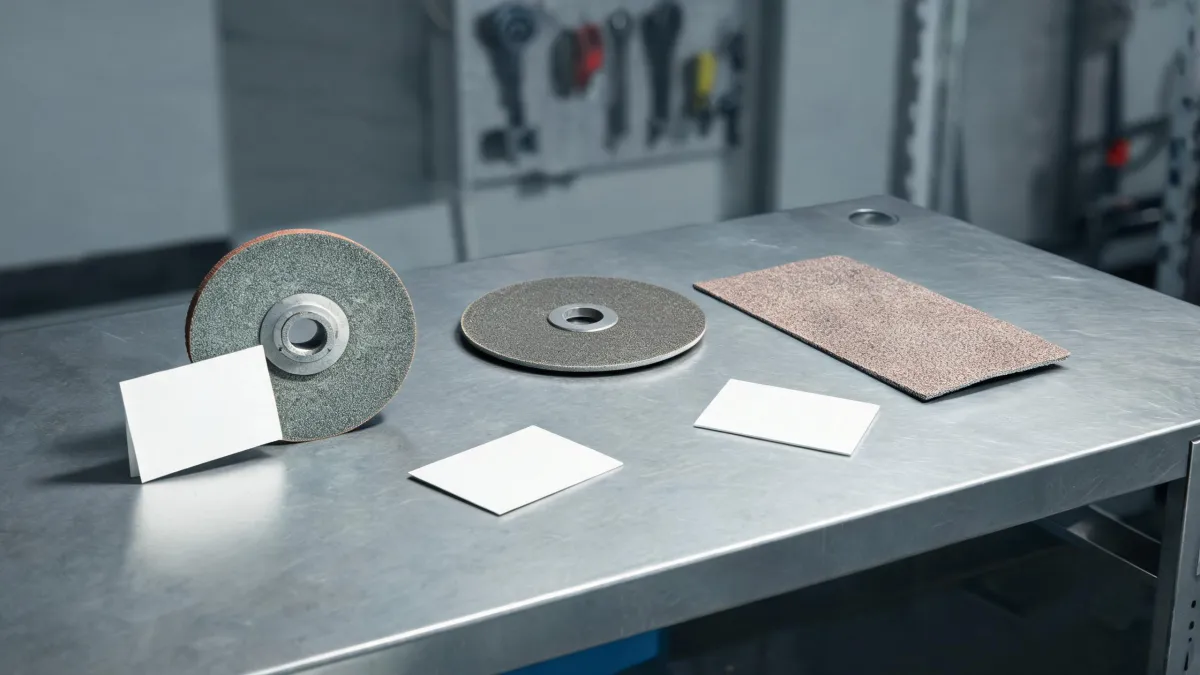
Norton Abrasives grinding wheels are not one product. The brand is one of the broadest abrasive lines in the industry, which is exactly why the brand name alone is not enough. Under the Norton name you will find aluminum oxide, ceramic alumina, zirconia, silicon carbide, vitrified bonds, resinoid bonds, and dozens of grain and structure combinations. Some are made for stock removal, some for finish, some for tool and cutter grinding, some for portable grinding or cutoff work. Two wheels can look the same, fit the same machine, and still perform completely differently.
I’m not going to pretend I can decode every letter in Norton Abrasives 38A220-HVBE the way our toolroom lead can. What I know now is that the code identifies a specific grain, grit, grade, structure, and bond. A small difference in one letter can change how the wheel wears, how it feels on the workpiece, and how much heat it puts into the steel. If the code says 38A220-HVBE, then “similar” is not a substitute. Similar is a return label.
What made this harder is that the old shortcut no longer works. A purchasing agent could once get away with ordering by brand because the category was smaller. By 2025, online catalogs are deeper, inventory is more precise, and what seemed like fine practice in 2020 can leave you with an expensive box in the corner. The fundamentals, know your grit, know your bond, know your machine speed, have not changed. But the execution has to be more disciplined.
The real cost of the wrong Norton Abrasives grinding wheel
I don’t have hard data on how many wrong abrasive orders happened before we changed the process. What I can say from the returns I handled is that it was more than one, and the most visible cost was never the wheel itself.
When I added up the 2023 mistake, the vendor’s restocking fee was 25% of the order. Add two rushed deliveries and the maintenance lead’s time, and the false saving disappeared. I am not against comparing prices. I just don’t compare until I know the correct product code.
There is also a safety dimension. Per ANSI B7.1, a wheel’s rated speed should be equal to or greater than the spindle speed of the machine it is mounted on. That is why I now record max RPM from the label on our inventory tag. If a product listing doesn’t show the rating clearly, I move on. No discount is worth the odds.
The check valve catalog connection
The odd thing that made this click was not another abrasive order. It was a check valve. We needed a replacement check valve for the compressor package. I opened a generic check valve catalog, found something that looked correct, and nearly ordered it. Then I called one of our local air compressor distributors.
The person on the phone asked for the compressor model and line size. When I gave it, the answer came back from the manufacturer’s check valve catalog: “That one works, but it has the wrong cracking pressure. Use this model instead.”
That conversation changed how I buy technical products. A distributor who can find the right valve in a check valve catalog is doing the same thing a good abrasive supplier does with a Norton product code: matching an engineered product to the actual application instead of matching a photo.
What I do now
The solution is not exciting. It’s also not optional in my office anymore:
- If the shop gives me a part number, the purchase order uses the full part number. Example: Norton Abrasives 38A220-HVBE.
- A substitute must be confirmed by the manufacturer or an authorized distributor with a cross-reference, not by a listing that looks close.
- Receiving compares the product label to the PO and logs the max RPM.
- For catalog-heavy parts like check valves, our approved list includes air compressor distributors who will do a quick lookup before I place the order.
And yes: how to change a disc on an angle grinder
Since that term is one of the reasons people land here, here is the direct answer from the person who trained me to stop making this complicated.
- Disconnect the grinder from power or remove the battery, and wait for the wheel to stop completely.
- Press the spindle lock and turn the disc by hand until the lock engages.
- Use the grinder’s supplied wrench to loosen the outer flange. Check the grinder manual for the direction; on many models it is counterclockwise when you are looking at the wheel face.
- Remove the old disc and inspect the flange and threads. If the old wheel is chipped, glazed, or damaged, that is useful information for the next order.
- Mount the new disc. Confirm the bore size matches, the arrow on the wheel matches the grinder’s rotation direction if one is marked, and the label shows a speed rating that covers the grinder.
- Tighten the flange firmly, release the spindle lock, and run the grinder at no load for a few seconds with the wheel pointed away from you.
The disc change itself is the last and easiest step. The hard lesson I learned is that the right Norton product code matters just as much as knowing how to use a wrench. Write the code down, keep the code on the PO, and let the people who stock these products help you if a number doesn’t look right.
My experience is limited to one mid-sized shop and a lot of catalogs. If you are buying for high-production abrasive applications, your process may need to be even tighter. But the principle will not change: code first, catalog second, compare third.

Maren Jorgensen
Maren Jorgensen is an independent hand tool and torque applications analyst covering wrenches, pliers, screwdrivers, hammers, sockets, ratchets, hex keys, and tool sets. She applies ISO 6789-1 torque-tool conformance principles while examining jaw capacity, leverage, fastener engagement, torque range, accuracy, handle geometry, and material hardness. Her practical guides help tradespeople and procurement teams select suitable tools, plan controlled tightening, and compare durability without relying on brand reputation alone.