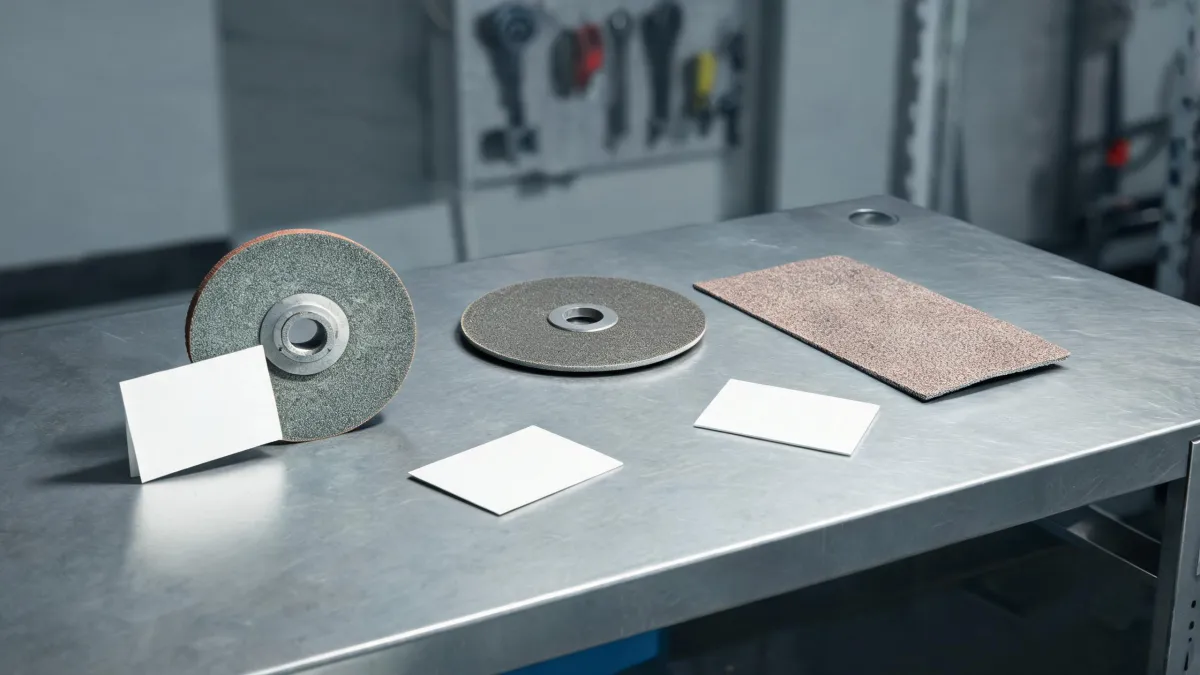
In my role coordinating same-day tooling orders for industrial and contractor clients, I've learned that speed is overrated until compatibility is proven. I've handled more than 300 rush orders in seven years, and the expensive delays almost never came from trucks being slow. They came from grabbing the wrong product. The fastest fix for most urgent grinding jobs is a verified Norton abrasives grinding wheel, used only after someone checks arbor size, RPM, and material. Everything else is just waiting to fail.
Before I get into specific products, let's clear up a common misconception. People think rush orders cost more because the work is harder. Actually, rush orders cost more because they're unpredictable: expedited freight, missed phone calls, and the lurking risk that the box on the dock has the wrong wheel. That unpredictability is what kills deadlines. A good checklist reduces it.
Why I Reach for Norton Abrasives Grinding Wheels
I don't claim Norton is "the best" in a marketing sense. I don't trust blanket claims. I trust Norton because the product range is deep enough that my distributor inventory can cover most urgent calls. When a shop calls at 11 a.m. about a weld that has to be gone by tomorrow, the boring details matter more than cool product names: max RPM, arbor hole, grit, bond. Norton's data sheets give me those details in a reliable format. That's enough for me to quote a delivery time without crossing my fingers.
One thing I now do on every urgent grinding order: ask for a photo of the grinder's spindle or a measurement of the arbor hole. It sounds unnecessary, but I've shipped a 5/8-inch arbor wheel for a 1-inch arbor more than once in my early years. On a compliance level, ANSI B7.1 and EN 12413 both make the operator responsible for matching wheel speed to the grinder. That number is on the wheel's label. If the label is missing, the wheel does not get mounted.
Norton Abrasives F240: Fine Grit, Fine Finish, Not a Shortcut
Let's talk about Norton Abrasives F240. F240 is a fine-grit designation in the FEPA grit system, not a magic material. In practical terms, a Norton product with that F240 label is for finishing, blending, and surface refinement. It is not a stock-removal tool.
In March 2024, a fabrication shop called 36 hours before a stainless railing inspection. They'd been blending a weld with a fine finishing product and were proud of the surface. The problem was the weld was still too high. The F240 had made the mistake beautiful, but the metal was still proud. We sent a coarser Norton grinding wheel, they spent a couple of hours on the rough pass, then switched to the F240 and got a good final finish. If they'd started with the right sequence, they would have saved the whole panic.
That story taught me to ask a different question first: what are you removing? Not "what finish do you want?" Not "how much time do you have?" If you need metal gone, start coarse. Save the F240 for the last pass.
A Bi-Metal Hole Saw Set Belongs in Every Deadline Kit
Rush jobs rarely stop at grinding. Panels need openings, brackets need mounting holes, locks need to be removed. That's why I keep recommending a bi-metal hole saw set. If you're looking at Norton, the CMAH1SET7 is the model number I've seen in several distributors' inventories—a seven-piece bi-metal set, unless Norton changed the kit packaging recently (check the current SKU before ordering).
The advantage of bi-metal over cheap carbon-steel hole saws is simple: it survives contact with steel without losing teeth. A clean hole on the first pass is prevention over cure. I'd rather spend a few more dollars on a decent hole saw than watch a maintenance person try to ovalize a drilled hole with a file at the end of the day.
How to Take Off Caster Wheels Without Destroying the Caster
One of the most common urgent-need calls I hear does not involve abrasives at all: "how to take off caster wheels?" It's usually a maintenance person with equipment down, staring at a stuck wheel. The fastest answer is to identify which part is stuck before reaching for a grinder.
- Look at the mounting. If the caster has a plate on top, block the equipment, remove the bolts, and the entire caster assembly comes off. If it has a threaded stem, remove the nut or the retaining clip under the frame.
- If you need the wheel off the fork, remove the axle. A bolted axle has a head on one side and a nut on the other: hold the nut, turn the bolt head. If it spins, use an impact wrench or a nut splitter.
- If the axle is pressed in, punch it out from the non-threaded side. Don't pry at the wheel while the axle is still in place unless you want a bent fork.
- If the caster is rusted, spray penetrant and wait ten minutes. Heat works, but remove the wheel first if there is any plastic bushing or bearing seal near the axle.
Do not use a grinding wheel to cut a stuck axle while the caster is still attached to equipment. Sparks near gas springs, hydraulic lines, or debris are not worth the five minutes you might save. I've watched a $50 caster removal turn into a $500 repair because someone wanted to skip the penetrant step.
The Checklist Is the Real Insurance
The company I work for now requires a photo on any order that needs to ship same day. We lost a significant account in 2022 because I sent a wrong arbor size—not Norton's fault, mine. I still kick myself for not asking for a photo. Since then, the photo rule has saved us more times than I can count. Last quarter, we handled 47 rush orders with only two small hiccups, and both tracing back to specs we couldn't verify.
That's the prevention-over-cure argument in a sentence: five minutes of verification beats five days of correction, and the correction is never just the part cost. It's line-down cost, freight cost, and someone's lost evening.
Boundary Conditions
Norton abrasives grinding wheels are a solid default, but they are not universal. If you're cutting concrete, you need a diamond blade, not a bonded grinding wheel. If you need to remove a rusted thread, a thread file or nut splitter is safer than a grinder. If you're trying to get a polished finish on a welded stainless rail, the F240 can be the right final step—but it is not the first step.
The same goes for products like the CMAH1SET7: model numbers and kit contents change, and your local inventory differs from mine. Use the official Norton datasheet to verify the current part before you place the order. That's not a disclaimer; it's exactly the kind of verification that keeps a rush order alive.

Maren Jorgensen
Maren Jorgensen is an independent hand tool and torque applications analyst covering wrenches, pliers, screwdrivers, hammers, sockets, ratchets, hex keys, and tool sets. She applies ISO 6789-1 torque-tool conformance principles while examining jaw capacity, leverage, fastener engagement, torque range, accuracy, handle geometry, and material hardness. Her practical guides help tradespeople and procurement teams select suitable tools, plan controlled tightening, and compare durability without relying on brand reputation alone.