-
Mistake #1: The $80 Grinding Wheel "Deal"
-
Norton Abrasives Polerpads: The Finish That Saved a $350 Job
-
What Is an Angle Grinder For? The 30-Second Version
-
Ear Clamp Pliers: Product Info and Reviews from the Shop Floor
-
The Bi-Metal Saw Blade Set 11-Pack: A $6 Mistake That Cost $48
-
The Misconception: "Norton Is Only for Big Shops"
-
What I'd Tell Another Small Shop Owner
-
Small Isn't a Penalty
I run a four-person metal fabrication shop. One bay, one old forklift, and a consumables budget that would make an industrial plant manager laugh.
Here's my honest opinion: small shops don't need cheap abrasives. They need real ones. The moment you accept a "good enough" wheel because it's $1.60 less, you're betting the workpiece, your deadline, and the shop's reputation against a rounding error.
I can say this because I've lived the alternative. In eleven years of running the shop, I've personally made and documented 14 significant purchasing mistakes, totaling roughly $8,500 in wasted budget. That number lives in a spiral notebook next to our inventory board, and new hires read it before they touch an angle grinder.
So when I talk about abrasive selection, I'm not selling you a theory. I'm showing you a ledger.
Mistake #1: The $80 Grinding Wheel "Deal"
In 2021, I ordered 20 unbranded grinding wheels from a marketplace listing. Same diameter as the Norton Abrasives grinding wheels we'd been quoted. Similar grain color. Nearly half the price per piece. It looked like smart buying. It wasn't.
Within the first hour, the wheel was cutting slow and wearing fast. By the third piece, it started vibrating—badly. At 11,000 RPM, a vibrating wheel on a 5-inch angle grinder isn't an inconvenience. It's a projectile waiting for a target.
Here's what I know now, thanks to a safety rep who chewed me out after I told him about it: abrasive wheels in the US are covered by ANSI B7.1, which requires the maximum operating speed to be marked on every wheel. The wheels in that listing had a stamp that was nearly illegible. That should have been the red flag. A clear, permanent RPM rating is the first thing I check now—and the ring test (tap the wheel gently with a non-metallic tool; you want a clear ring, not a dead thud) is the second.
I swapped back to the Norton wheels and did a rough comparison on the same steel. The cheap wheel lost diameter visibly after about 14 minutes of real cutting. The Norton wheel stayed in the cut for close to 30. Price difference per wheel: $1.80. Cost per cut: the cheap option was 30% more expensive, plus one hour of downtime and a re-cut on a schedule-40 pipe that I'd rushed with the tired wheel.
Simple math. Took me $320 and a near-miss to learn it.
Norton Abrasives Polerpads: The Finish That Saved a $350 Job
My second mistake was about a finish, not a cut. We'd landed a small contract to polish a stainless steel display frame for a local retailer. Small job. Right in our wheelhouse. I grabbed a general-purpose flap disc off the bench because it was convenient.
The result looked like somebody had bathed the frame in acid. The aggressive backing scratched the stainless so deeply that the damage was visible from across the room. $350 of material turned into scrap, plus a phone call to the client that I still remember too clearly (ugh).
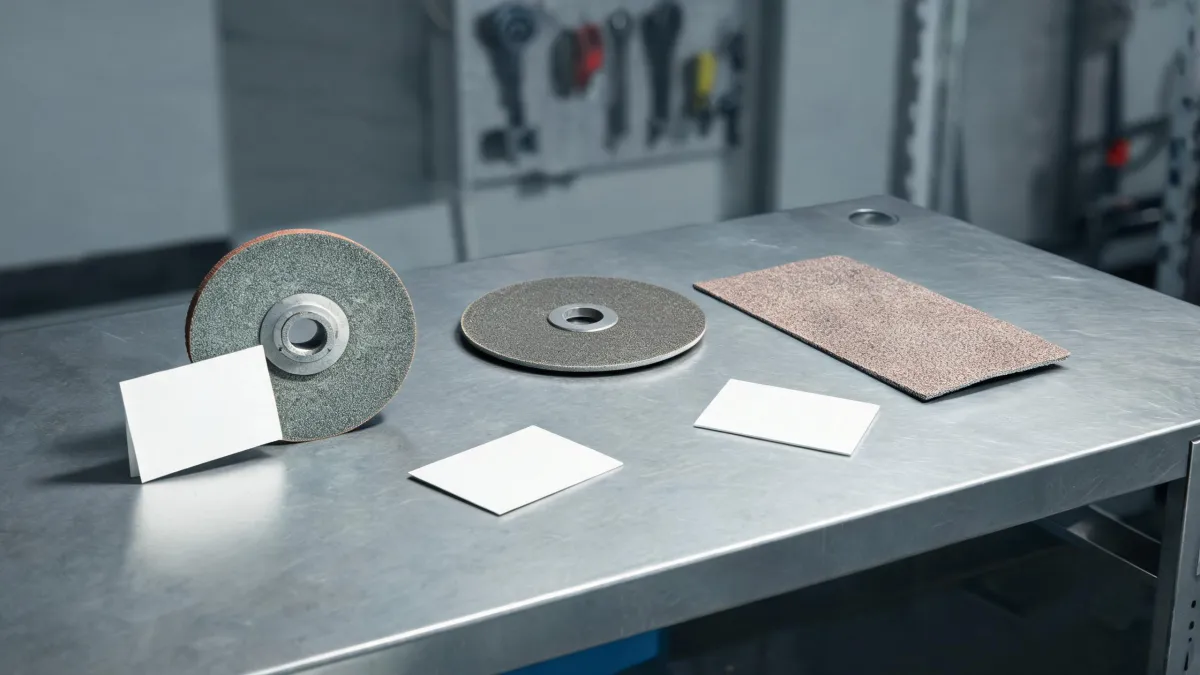
The repair was straightforward: a Norton Abrasives polerpads kit on a variable-speed grinder. These are finishing pads—wool, foam, and microfiber—designed to step a surface through progressively finer passes. Same tool, completely different job. The flap disc removes stock. Polerpads restore a finish. The rework took about 20 minutes, and the client accepted the second pass without a comment.
That was the moment I started paying attention to the difference between "an abrasive" and "the right abrasive."
What Is an Angle Grinder For? The 30-Second Version
People ask this more than you'd think, especially when a job goes sideways. Here's the short answer: an angle grinder is an attachment-driven system. Cut-off wheels slice. Grinding wheels remove heavy stock. Polerpads and flap wheels finish and polish. Each family is a separate product category, and mixing them up is how you turn a $350 part into a $350 lesson.
Our shop shelf is color-coded now—red for cutting, blue for grinding, yellow for finishing. That shelf exists because I learned the hard way that an angle grinder is only as smart as the hand picking the disc.
Ear Clamp Pliers: Product Info and Reviews from the Shop Floor
The pattern echoed outside the abrasive aisle once I knew what to look for. Ear clamp pliers are a good example. For too long, I used standard pliers on Oetiker-style ear clamps and told myself it was fine. It wasn't. The crimp was uneven, and a coolant line leaked right after a test run—the kind of failure that costs you a Saturday and a customer's confidence.
The real product is simple: a pair of pliers with jaws that fully close an ear clamp in one squeeze, creating a uniform crimp on both sides. When you're shopping, look for a reversible two-position pivot for open and closed clamp styles, replaceable jaws, and long handles for mechanical advantage. That's the entire product info that matters in practice. As for my review: the right pair turns a frustrating, leak-prone 20-minute job into a two-minute certainty.
The Bi-Metal Saw Blade Set 11-Pack: A $6 Mistake That Cost $48
Same story, different aisle. I bought a bi-metal saw blade set 11-pack from a hardware store promotion, seduced by the per-blade price. Bi-metal construction is legitimately good technology: high-speed steel teeth welded to a flexible alloy body, giving you durability and bend resistance in one blade. In theory. In practice, the quality control on that 11-pack was not consistent.
One blade snapped mid-cut on a mild steel flat bar. The blade's share of the 11-pack was about $6. The workpiece was $42. The re-cut consumed an hour of an already busy afternoon.
A lesson learned the hard way: when a tool fails, the tool isn't the whole cost. The workpiece, the labor, and the deadline are attached to it.
The Misconception: "Norton Is Only for Big Shops"
Here's the belief I want to dismantle, partly because I held it for years: that international abrasive brands like Norton Abrasives only make sense for factories ordering by the pallet. I assumed our four-person shop was too small for that level of product. I was wrong.
Granted, I can only speak to my context: a small custom shop, two states, moderate ordering frequency. Our distributor has never once batted an eye at a 20-wheel order. Norton Abrasives grinding wheels come in the numbers we need. Polerpads arrive when a finishing job demands them. There's no minimum-order gatekeeping, no sense that our business is too small to matter.
When I need a spec sheet these days, I go straight to the "norton-abrasives" listing in our distributor's portal—it's faster than digging through a paper catalog.
To be fair, if you're buying one loose wheel in a big-box hardware store, you're paying walk-in retail markup. That markup isn't a brand penalty—it's a channel cost. On a 20-wheel order, the per-cut cost conversation gets interesting quickly. Price per wheel matters less than cost per cut, and the wheel that cuts 30 minutes instead of 14 is the cheaper wheel, regardless of what it costs at checkout.
And look—I'm not going to argue Norton is the right answer for every job. If you occasionally cut a threaded rod or trim rebar on a Saturday, a cheap wheel gets you there. The performance gap narrows when the work is light and occasional. But for a business that sells its workmanship, "probably fine" is a weak standard.
Looking back, I should have invested in serious abrasives from day one. At the time, the price gap felt enormous because I was thinking in cost per wheel. I wasn't counting the 14-minute wheel as 14 minutes of labor plus a trip to the material rack plus a deadline that doesn't care what the wheel cost.
What I'd Tell Another Small Shop Owner
If you're running a small shop and don't want to donate $8,500 to the same education, here's the condensed version:
- Match the abrasive to the task. Cutting wheel for cutting. Grinding wheel for grinding. Polerpad for finishing. They are not interchangeable.
- Track cost per cut, not cost per wheel. The more expensive wheel that lasts twice as long is the bargain.
- Check the rating before mounting. ANSI B7.1 says the max RPM must be marked on the wheel. If you can't read it, don't run it. And do the ring test.
- Buy through a supplier that respects small orders. A distributor relationship beats a walk-in retail aisle.
- Use the right tool for the job. Whether that's polerpads for stainless or ear clamp pliers for hose fittings, the right tool is the baseline, not an upgrade.
One caveat on my sample size: I've been through roughly 90 supply orders in three years, mostly small to medium batches. If you're buying by the pallet or working with exotic alloys, your experience may differ. That's fair. This advice is aimed at the four-person shops—the ones where one bad wheel is a real loss, not a line item.
Small Isn't a Penalty
My bottom line hasn't changed in four years: a small shop deserves the same quality, consistency, and respect as a factory floor.
I used to think serious abrasives were something I'd graduate to once we grew. I had it backwards. The consumables you choose are part of how a business grows—not a reward for growing. A failed job costs a four-person shop the same as it costs a forty-person shop. It just hurts more when there's no one else to absorb it.
So yes, I'll keep saying it: small orders are not small problems. They're real work, with real budgets, and real consequences when the wrong product spins up at 11,000 RPM. The Norton Abrasives polerpads sit on the yellow shelf. The grinding wheels are on the blue shelf. The ear clamp pliers hang next to the test bench. And the 11-pack of bi-metal blades? It's still there, with its surviving members used only for accurate, non-negotiable jobs—because I check the tool and the rating and the design now, instead of trusting the packaging.
That's the whole point of the ledger. I don't keep it to feel bad about mistakes; I keep it so the next person doesn't have to buy their own copy of every lesson.

Maren Jorgensen
Maren Jorgensen is an independent hand tool and torque applications analyst covering wrenches, pliers, screwdrivers, hammers, sockets, ratchets, hex keys, and tool sets. She applies ISO 6789-1 torque-tool conformance principles while examining jaw capacity, leverage, fastener engagement, torque range, accuracy, handle geometry, and material hardness. Her practical guides help tradespeople and procurement teams select suitable tools, plan controlled tightening, and compare durability without relying on brand reputation alone.