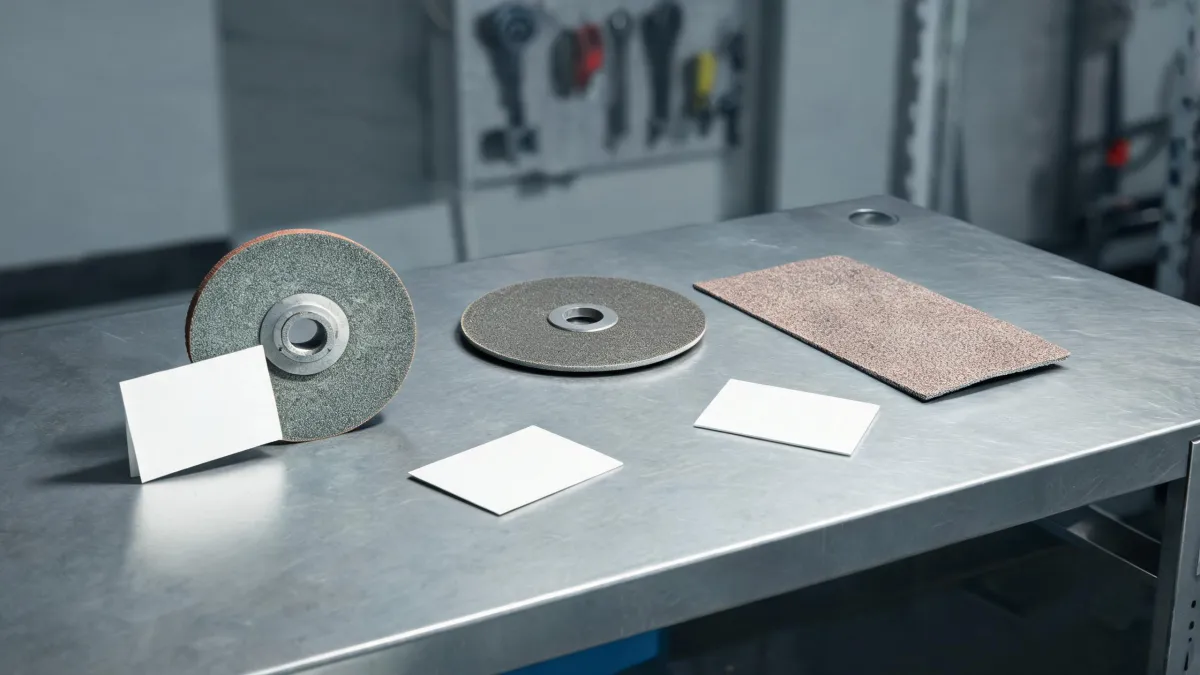
If you're searching for 'what to look for in an angle grinder,' you're probably starting with the wrong part. The grinder is just the motor. The wheel is the part that actually touches the metal, and that's where I've made the most expensive mistakes.
I don't write this as a tool reviewer. I've maintained tooling and consumables for a 12-person metal fabrication shop since 2017. I've made enough bad abrasive orders that the checklist below now lives on the wall next to the grinding rack. This article is that checklist, minus the coffee stains.
Why I start with the abrasive, not the motor
Norton Abrasives Saint-Gobain sounds like a corporate mouthful until you need to check a speed rating. Norton Abrasives is the abrasives side of Saint-Gobain, and one reason I keep coming back to it is that the product labels are clear. In a Norton Abrasives catalogue, you can find the required spec for almost every common wheel: type, diameter, thickness, grain, arbor size, and maximum RPM.
That matters more than you think. A grinding wheel is a safety device. It has a designed thickness, a designed bore, and a maximum speed. If a marketplace listing says 'fits all angle grinders,' that's a sign to go check the actual manufacturer specs. Universal fit doesn't mean universal safety.
What to look for in an angle grinder before comparing amp ratings
Most people ask about amps first. I check four things first:
- Wheel size and arbor hole. The 4.5-inch size is the sweet spot for a lot of metalwork. A common 4.5-inch wheel family uses a 7/8-inch arbor, and the Norton 4-1/2 in. metal 5-pack is in that family. Before you buy any machine, confirm that it matches the wheel you can actually buy locally or online. If the arbor is wrong, no adapter story should save the day.
- Speed rating match. The maximum RPM printed on the wheel has to be at least as high as the no-load speed of the grinder. A 4.5-inch grinder in the 7.5-amp class is often around 10,000 RPM no load, and many common Norton wheels are rated above that. Even so, check the label every time. A wheel marked 'fits 4.5-inch grinder' but with no max speed is a wheel I won't mount.
- Guard and control. What to look for in an angle grinder is not just power. A guard that stays in place and a side handle that doesn't feel awkward are part of the decision. If the guard is annoying to adjust, someone will eventually take it off, and then the grinder becomes a brake disc with a handle. Not good.
- Spindle lock. You will change discs more often than you think. A grinder with a spindle lock makes that job faster and makes operators less tempted to reuse a chipped wheel because changing it is a hassle.
A 7.5 amp angle grinder PC750AG is a good example of a 4.5-inch machine in this class. It won't feel like a 15-amp monster, but it doesn't need to if the wheel is matched to the job. If you put a sharp wheel on it and use it at the right angle, it can do a surprising amount of work.
There isn't one right angle grinder for everyone
Here's where I cringe at most buying guides. They write one long list of features and say 'buy this.' But the right answer in a shop depends on what you do all day. The same grinder that feels perfect for 20 minutes of weld cleanup can be the weakest station on a production floor.
I sort purchases into three situations.
Situation 1: Occasional grinding, under 20 minutes at a time
If you're cutting a rusted bolt, cleaning a weld on a trailer, or trimming a piece of flat bar, a compact 4.5-inch grinder is the right tool. A 7.5-amp motor is honest power for that level of work. It keeps the grinder light enough to hold with two hands without feeling like wrestling a machine.
In this scenario, you don't need the most aggressive wheel in the catalogue, either. A standard Norton 4-1/2 in. metal 5-pack will handle most mild-steel jobs. Keep it for grinding, not for deep cutting. If the job is mostly cutting, go down to Situation 3.
My first big grinder purchase was a heavier 7-inch machine because I figured more power equals more capability. It sat under the bench for two years. A 4.5-inch grinder did most of the actual work. I still kick myself over that one.
Situation 2: Regular fabrication or weld cleanup
If you use a grinder for metal fab on a weekly basis, the calculation changes. You're not buying a tool for a Saturday project. You're buying a production station, and the wheel is as important as the tool.
For heavy grinding, I would probably step up from the 7.5-amp class. A 10-amp or larger grinder has more reserve, so it doesn't bog down as quickly on a wide weld. That reserve is not about making you push harder; it's about letting the wheel work at a consistent speed.
Please don't skip the abrasive selection here. The Norton Abrasives catalogue has product families for different types of metal and different finishes. If you are using the wrong grain or the wrong wheel thickness, the grinder's amp rating won't save your day.
I learned this the expensive way in September 2022. I ordered 60 wheels based on diameter and price, checked the arbor, and skipped the application check. By late morning, the first wheel was loading up and the operator was forcing it. That $320 shelf order plus the rework cost is why the checklist now has a line that says 'application first.'
Situation 3: Most of your time is cutting metal
Here's the uncomfortable truth that most articles avoid: an angle grinder is not a substitute for a chop saw if you are cutting steel all day, but it can do a lot of light-to-medium cutting when you use the right disc.
For cutting, a thin cutoff wheel is the right product. Do not use a standard grinding wheel from a metal 5-pack in a deep slot. The grinding wheel is too thick, it is built to remove material on its face, and using it as a cutoff blade makes it slower, hotter, and more likely to grab.
Look for a reinforced cutoff wheel that matches the same 4.5-inch diameter and arbor. Norton's RightCut line is one example of this, but the exact product family matters less than the classification. Match a cutting task with a cutting disc, and a grinding task with a grinding disc.
A 7.5 amp angle grinder PC750AG with a thin cutoff wheel is capable on 1/8-inch flat stock and light tube. If you are cutting rebar or thick structural steel all day, spend the money on a dedicated abrasive cut-off saw rather than pushing an angle grinder past its design.
How to tell which situation is yours
Don't ask yourself what kind of person you are. Look at your last four weeks of real use.
- If your grinding wheels last for months and the grinder sits in a drawer most weeks, you're in Situation 1. A 7.5-amp angle grinder PC750AG and a Norton 4-1/2 in. metal 5-pack is a sensible setup.
- If the 5-pack disappears in a week and you spend hours cleaning welds, you're in Situation 2. Upgrade both the grinder and the abrasive grade, and don't let a production workflow run on random leftover discs.
- If your thin cutoff wheels disappear faster than your grinding wheels, you're in Situation 3. Treat cutting as its own task, buy the correct cutoff wheels, and reserve the metal grinding 5-pack for actual grinding.
If you are between situations, the solution is not one magical all-purpose disc. Keep one package of general grinding wheels and one package of cutoff wheels. Label the rack if you have to. That process takes ten minutes and saves far more time than a bigger motor.
My rule after a few expensive mistakes: match the abrasive to the job, then use the grinder to wake it up. The grinder isn't what you're buying. The system you can run without stopping is.
Keep the Norton Abrasives catalogue open while you order. It beats gambling on a vague product title and returning 60 wheels later.

Maren Jorgensen
Maren Jorgensen is an independent hand tool and torque applications analyst covering wrenches, pliers, screwdrivers, hammers, sockets, ratchets, hex keys, and tool sets. She applies ISO 6789-1 torque-tool conformance principles while examining jaw capacity, leverage, fastener engagement, torque range, accuracy, handle geometry, and material hardness. Her practical guides help tradespeople and procurement teams select suitable tools, plan controlled tightening, and compare durability without relying on brand reputation alone.