In April last year, at 7:18 on a Friday night, I got a call from a local contractor. He needed 48 stainless steel mounting brackets by 7 a.m. Monday. Normal turnaround for a custom fabrication order like that was three to five days. I said yes anyway. That's what I do. I'm the production manager at a metal fabrication shop, and I've handled more than 80 rush orders in ten years, including same-day turnarounds for clients who were desperate. After I hung up, I wondered if I'd overpromised. The thought followed me to the shop.
Here's the thing: I used to think a 4.5-inch angle grinder is a 4.5-inch angle grinder. Slap any wheel on it and it'll cut. That belief lasted until about 9 p.m. that night.
The contractor's order wasn't huge—around $400. Three other shops told him it was too small and too tight for a weekend job. He came to us because we aren't supposed to say no just because a customer isn't a big account. Small doesn't mean unimportant. It means potential. But if I'm honest, I almost treated it like a small deal in a worse way: I let the shop use the cheap wheels we had on the shelf, because I didn't want to spend extra on 'premium' consumables for a small job.
Two hours in, that decision was looking stupid. The wheels were struggling. The cut edges on the stainless bar stock were discolored, burrs were heavy, and every wheel started loading up after a few cuts. I kept stopping to swap discs with the grinder wrench, and each swap cost time. Around the fourth change, I started doing the math on how many wheels we'd burn through and how late we'd be.
My first mistake: assuming any grinding wheel could cut metal
Look, I'm not saying cheap aluminum oxide wheels are always terrible. On mild steel, they're fine. But this was T-304 stainless, and they were burning through time like I was paying them overtime. I was ready to call the customer and tell him we'd miss the deadline. The embarrassing part? The fix was already in the shop. I just hadn't opened the right box.
The twist: a Norton Abrasives Gemini 57A wheel
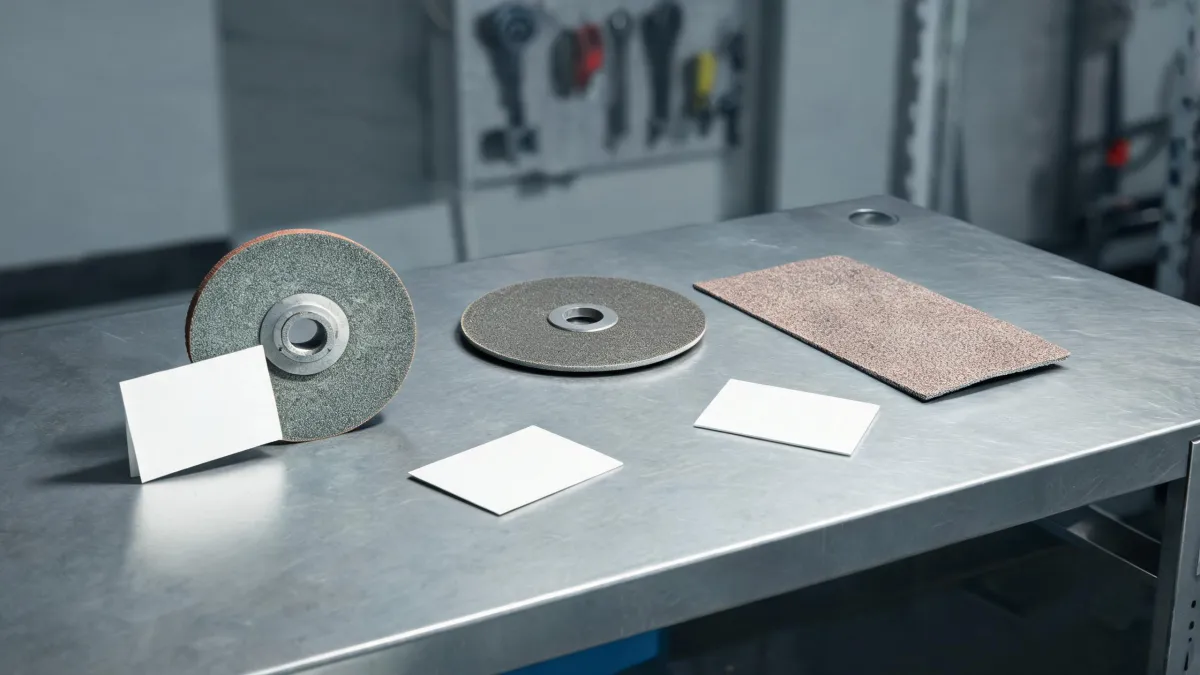
One of our technicians walked over and handed me a wheel without saying much. The label read: Norton Abrasives Gemini 57A. It looked like the same kind of wheel, just a different color. I told him, 'This isn't a magic wand.' He said, 'No, it's just not a sledgehammer.' I rolled my eyes and put it on the grinder.
The first cut was smoother. The spark pattern was different—more controlled, less violent. The edge came off clean. After three cuts, the wheel still looked like it had barely worked. After ten, it was still cutting true. I stopped checking the product info and started paying attention to what my hands and eyes were telling me.
That's when I finally understood why Norton Abrasives has the reputation it has. Norton Abrasives—trademark owner Saint-Gobain—has been around since 1885, and that pedigree shows in the grain technology. The 57A uses ceramic alumina grain designed for hard-to-grind metals like stainless steel and high-nickel alloys. It stays sharp longer and runs cooler, so it doesn't work-harden the material the way a generic wheel does. Cooler matters a lot on stainless.
The grinder wrench problem
Just when things were looking up, the job threw another punch. Around 11 p.m., I needed to swap the used 57A for a fresh one, and the arbor nut wouldn't budge. I reached for the generic grinder wrench we keep near the bench. It slipped. The nut had been over-tightened earlier, and the cheap wrench didn't fit well enough to break it loose.
I know a grinder wrench sounds like the most boring tool in existence. It's a piece of metal with two pins. But in that moment, it was the difference between finishing at 3 a.m. and fighting until dawn. The cheap wrench rounded the edge of the nut. I ran to the drawer and found the original T-shaped grinder wrench from a better grinder. It clicked onto the nut like it was made for it. Two seconds later, the wheel was off.
Now we have a rule: every angle grinder gets a real wrench, and we verify it before a rush job starts, not after we're stuck. It costs nothing. It saves hours.
Small order, big lesson
The customer wasn't a large account. He was a local contractor who had been passed around by shops that only wanted bigger fish. That's exactly why I should have given him our best stuff from the start. Instead, I nearly wasted his deadline to save eight dollars on consumables. The value of a guaranteed deadline isn't just speed—it's the certainty that lets the customer sleep at night. My job is to protect that certainty.
Here's the part I wish someone had told me years ago: small doesn't mean unimportant, it means potential. The contractor who needed 48 brackets at 7 a.m. on a Monday is the same contractor who might need 1,000 brackets next month. And when he does, he'll call a shop that treated his little order like it mattered.
Product info, reviews, and pruning shears
One thing I tell people now is to read product information the same way you'd read pruning shears product info and reviews before buying a pair. That might sound like a weird analogy, but it's not. You can look at blade steel and handle ergonomics on paper, but the real answer shows up after a couple hundred cuts. Same with abrasives. The spec sheet can tell you grain type, bond, and RPM rating, but the truth shows up on a stainless edge after 20 cuts. The Gemini 57A looked plain in the box. It did not behave plain.
So, does angle grinder cut metal?
Yes—if you use the right wheel. If you've ever asked 'does angle grinder cut metal?' the answer isn't a single yes or no. It's 'depends on the disc.' A thin cut-off wheel works on steel. A grinding wheel works on welds and heavy stock. For stainless and high-nickel alloys, a ceramic wheel like the Norton Abrasives Gemini 57A is my first choice. For aluminum, you might need a different wheel because aluminum loads up regular wheels fast.
If you're cutting a lot of stainless, the productivity difference shows fast. A wheel that lasts longer and cuts cooler means fewer changes, less grinder wrench time, and fewer rejected pieces. It's not about buying the most expensive thing in the catalog. It's about matching the abrasive to the material. The first time I used the 57A, I cut 12 brackets before the wheel showed any wear. The cheap wheel was done after five, and the edges were rough enough that I had to deburr them twice.
And before anyone asks: no, a masonry wheel won't cut steel. I've seen people try it. It glazes over, sparks dangerously, and can shatter. If you're not sure, check the wheel's RPM rating against your grinder, and never run a wheel above its rated speed.
What I'd do differently
If I could go back to that Friday night, here's what I'd change:
- Read the product info before the rush starts. The 57A is designed for stainless. That says it clearly on the label. I should have known that before the job began.
- Use the right consumables from the start. The cheap wheel cost us 45 minutes of grinder wrench swaps, rework, and stress. Labor is more expensive than abrasives.
- Treat every order like size doesn't determine urgency. Small jobs deserve the same attention, same product selection, and same follow-through as large ones.
In the end, we delivered the 48 brackets at 6:40 a.m., twenty minutes early. The customer paid the invoice on time and sent two more jobs our way. I also bought a pack of Gemini 57A wheels for any stainless work that comes in, and I made sure every grinder in the shop has a proper wrench nearby.
There's another part of this that I don't talk about enough: the customer's trust. He had already been let down by two shops that week. Watching the job come together in front of me made me realize that our answer to his small order was either going to prove him right about the industry or give him a reason to keep calling. I'm glad we chose the latter.
“The right tool isn't the one that's easiest to find. It's the one that's easiest on the job.”
That quote now hangs above our tool bench. It sounds a little cheesy, but it's true. If you're running a shop, take it from someone who almost missed a deadline over a $4 wheel: don't let assumptions get between you and the right tool.

Maren Jorgensen
Maren Jorgensen is an independent hand tool and torque applications analyst covering wrenches, pliers, screwdrivers, hammers, sockets, ratchets, hex keys, and tool sets. She applies ISO 6789-1 torque-tool conformance principles while examining jaw capacity, leverage, fastener engagement, torque range, accuracy, handle geometry, and material hardness. Her practical guides help tradespeople and procurement teams select suitable tools, plan controlled tightening, and compare durability without relying on brand reputation alone.