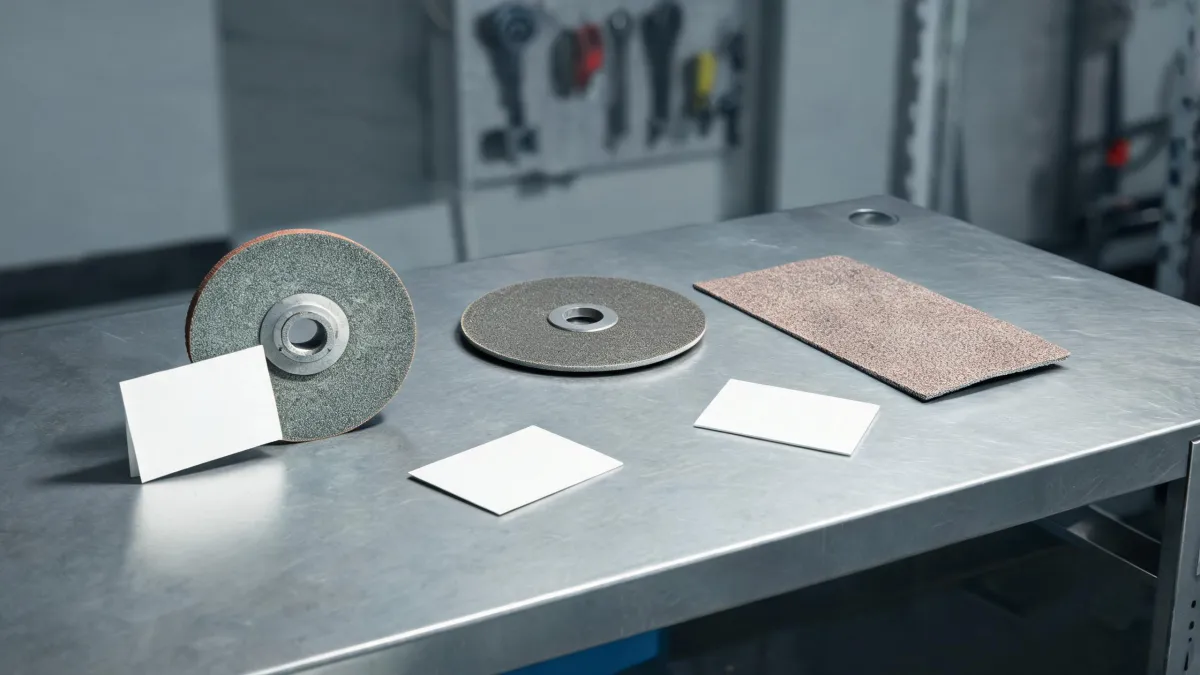
-
The $12 Disc That Turned Into a $3,200 Problem
-
The Surface Problem: "They Look the Same, So They Must Work the Same"
-
The Deep Cause: Why Spec Sheets Lie (and What They Don't Tell You)
-
The Real Cost: What Happens When You Treat Discs as Commodities
- What Actually Matters When You Buy Abrasives
-
The Bottom Line (and Why I'm Not Going Back)
The $12 Disc That Turned Into a $3,200 Problem
I still remember the email. Tuesday morning, Q2 2024. Our lead fabricator sent a photo: a Norton Gemini 57A disc that had shattered mid-cut on an 8-inch pneumatic wheel. No one was hurt, which was luck. The job? Three hours behind. The customer? Already threatening to walk.
We'd been buying discs from a discount supplier for eight months because, on paper, they looked identical to the Norton stuff. Same diameter. Same arbor. Same thickness. "Are all angle grinder discs interchangeable?" I'd asked our tool guy. He'd shrugged and said yeah, pretty much—you just match the size. That shrug cost us $3,200 in a single day.
If you've ever stood in a supply room, squinting at two discs that look exactly the same and wondering why one costs $12 and the other costs $4, you know that nagging feeling. Here's what I learned the hard way: that nagging feeling is your gut telling you something your spreadsheet can't see.
The Surface Problem: "They Look the Same, So They Must Work the Same"
Let's start with what most procurement teams see when they compare abrasive discs. You've got diameter. You've got arbor hole size. You've got thickness. Maybe you've got max RPM printed somewhere in small type. If the numbers match, the disc is "compatible," right?
That's what I thought for six years. I'd built a whole vendor comparison spreadsheet around these specs. Vendor A quoted $3.80 per disc for a 4.5-inch grinding wheel rated at 13,300 RPM. Vendor B—the Norton abrasives company distributor—quoted $9.20 for what looked like the same thing.
I went with Vendor A. Saved us $5.40 per disc. Across 400 discs that quarter, that's $2,160 in "savings." My boss loved it. I felt like a genius.
Then the returns started. Not the kind you send back to the vendor. The kind where the disc glazes over after 20% of its expected life, and your fabricator has to stop, swap it out, re-dress the workpiece, and start over. The kind where the cut quality drifts just enough that you're spending an extra 15 minutes per part in finishing.
I didn't see any of that in my spreadsheet. Because my spreadsheet didn't track fabricator frustration. It tracked unit price.
The Deep Cause: Why Spec Sheets Lie (and What They Don't Tell You)
Here's where I had my first real shift in thinking. I sat down with our senior fabricator—the guy who's been running grinders for 22 years—and asked him to walk me through what actually happens when a disc hits metal.
He pulled out two discs: a cheap import and a Norton BlueFire flap disc. Same 4.5-inch diameter. Same 7/8-inch arbor. He pointed to the backing plate. "Feel this," he said. The cheap one flexed noticeably under thumb pressure. The Norton one felt like a coin.
Then he showed me the abrasive grain. Under a magnifying glass, the cheap disc's grain looked like crushed gravel—uneven sizes, random distribution. The Norton disc's grain was uniform, almost engineered. "That's how they control the cut rate," he said. "And that's why yours glazes over. The grain's not sharp enough to self-sharpen as it wears."
This is the part that no procurement spreadsheet captures: abrasive discs aren't widgets—they're engineered consumables. The spec sheet tells you if a disc will physically mount to your grinder. It doesn't tell you:
- Grain structure and hardness—determines whether the disc cuts freely or rubs and burns
- Bond strength—affects how long the disc holds its shape under pressure
- Backing material quality—cheap fiberglass can delaminate at high RPM
- Actual operating life—the only metric that matters for total cost
I ran a controlled test after that conversation. Same grinder, same operator, same steel. One cheap disc, one Norton rightcut wheel. I weighed each disc before and after, tracked cut time, and logged surface finish quality on a 1–5 scale.
The cheap disc removed 34% less material before needing replacement. It took 18% longer per cut. And the finish quality averaged a 2.8 vs. the Norton's 4.1. When I ran the numbers, the "$5.40 savings" per disc actually cost us $11.70 in labor and rework per disc. We were losing $6.30 every time we put one on a grinder.
The Real Cost: What Happens When You Treat Discs as Commodities
I've tracked our abrasive spending for six years now. In 2024, we processed 2,847 individual abrasive disc orders across three facilities. Here's what the data showed when I separated "cheap" discs from "specified" discs:
Cheap discs: 41% higher replacement frequency. 22% more operator downtime for swaps. A measurable increase in surface prep time on weldments—about 12 minutes per unit across 180 units in Q3 alone.
The hidden line item: rework. When a disc fails to cut cleanly, your fabricator compensates. They push harder. They use a different angle. They create heat. That heat warps thin-gauge steel. Suddenly you're not just replacing a disc—you're redoing a weld, or worse, scrapping a part.
In Q3 2024, we had 14 documented rework incidents tied directly to abrasive performance. Average cost per incident: $240. That's $3,360 in a single quarter, from a decision I'd made to save $5.40 per disc.
"Never expected the budget disc to fail on a Friday afternoon job with a rush deadline. Turns out the 'cheap' option wasn't cheap at all—it was just a delayed expense."
But the real wake-up call wasn't the money. It was the safety report. A delaminated backing plate on an 8-inch pneumatic wheel doesn't just stop cutting. It explodes. At 6,000 RPM, a disc fragment carries enough energy to embed itself in drywall. We got lucky. The next shop might not.
What Actually Matters When You Buy Abrasives
After two years of testing, tracking, and having uncomfortable conversations with our CFO, here's the framework I use now. It's not complicated, but it's not what most procurement teams default to.
1. Stop comparing unit price. Start comparing cost per cut.
I built a simple calculator: (disc cost ÷ number of cuts) + (labor rate × time per cut) + (rework rate × average rework cost). When I ran the numbers, the Norton Gemini 57A—at nearly triple the unit price—came out 18% cheaper per finished part than the discount alternative.
The numbers said go with the premium option. My gut said the same thing, but for a different reason: our fabricators stopped complaining. That's worth something.
2. Match the disc to the machine, not just the arbor.
An angle grinder g13sc2m runs at 11,000 RPM no-load. That doesn't mean every 4.5-inch disc rated for 13,300 RPM is safe. The rating is a maximum, not an operating target. Cheap discs often have inconsistent bond density—they might hold together at 13,300 RPM in a lab, but fail at 9,000 RPM under real-world side load.
Check the manufacturer's recommended operating range. Not just the max.
3. Standardize where it makes sense. Customize where it doesn't.
We standardized on Norton for our high-volume grinding and cutting. For low-volume specialty work—odd angles, tight spaces, exotic materials—we test specific products from other brands. The key is having a process, not a blanket policy.
4. Track total cost, not purchase orders.
Your accounting system probably categorizes abrasives as "consumables" or "MRO supplies." That's where the visibility dies. I created a separate line item for "abrasive-related downtime" and "abrasive-related rework." The first month, it totaled $1,470. That was the number that finally got leadership's attention.
The Bottom Line (and Why I'm Not Going Back)
We switched our primary abrasive supply back to Norton in Q4 2024. Our per-disc cost went up 22%. Our total abrasive-related spend—including labor, downtime, and rework—dropped 31% in the first two quarters.
There's something satisfying about a fabricator who stops mid-cut to say, "This disc is still sharp." After two years of watching them fight their tools, that's the payoff.
If you're still asking "are all angle grinder discs interchangeable," the honest answer is: physically, sometimes. Economically, never. The disc that costs $4 and dies in 15 minutes isn't cheaper than the one that costs $12 and runs for 45. It's just a more expensive way to buy the same cut.
Check your specs. Track your actual costs. And trust the person holding the grinder—they know things your spreadsheet doesn't.
Prices and performance data based on internal tracking from Q1 2023–Q4 2024. Actual results vary by application, operator technique, and material. Always follow manufacturer safety guidelines and ANSI B7.1 standards for abrasive wheel safety.

Darius Campbell
Darius Campbell is an independent power tool and cordless systems analyst covering drills, impact drivers, impact wrenches, grinders, circular saws, rotary hammers, and jigsaws. He uses IEC 62841-1 safety requirements while comparing rated input, battery voltage, torque, no-load speed, duty cycle, vibration, dust control, runtime, and accessory compatibility. His evaluation articles help contractors and buyers match tool platforms to workload, mobility, service conditions, and total battery-system cost.