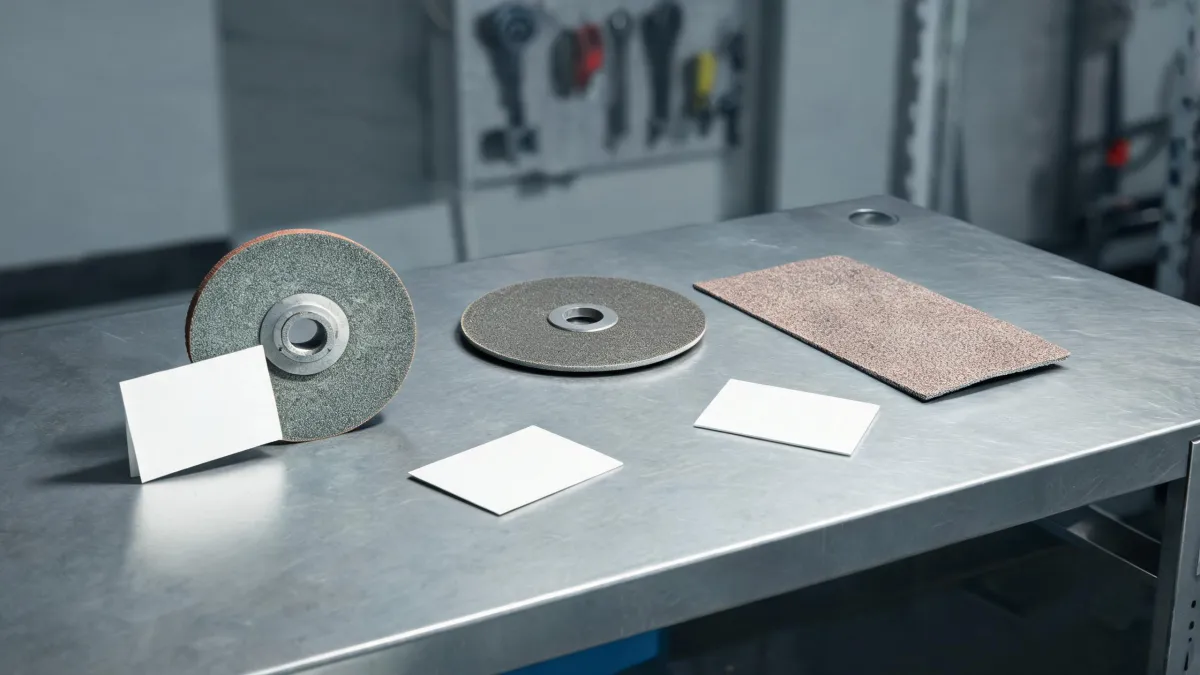
The first time I watched someone try to grind concrete with an angle grinder, I was standing in a loading dock holding a clipboard. It was a Thursday in March, and a delivery had just landed: 20 budget angle grinder wheels I'd ordered because they were $8 each and the facilities budget was tight. The maintenance lead took one look at the box and said, “You ordered these?”
That was my first red flag. I ignored it.
I'm the office administrator for a 140-person manufacturing company. My job involves a lot of requests that don't fit into a neat category. One month I'm calling our hydraulic pumps supplier to verify a quote. The next month I'm sourcing specialty tools and hand tools products for a shop supervisor. This time the request was for a grinding wheel to smooth a concrete patch in front of the warehouse floor coating crew.
The maintenance lead had actually put a specific part on the request: a Norton Abrasives grinding wheel for concrete. He didn't shout. He didn't emphasize it. He just typed the brand into the request and submitted it. I didn't know Norton from any other brand at the time, so I applied my usual logic: if the specs look the same and the price is lower, go with the lower price.
Why I Went Back and Forth on the Norton Abrasives Grinding Wheel
To be clear, I didn't blindly buy the $8 wheel. I went back and forth between the budget wheel and the Norton Abrasives grinding wheel for almost two weeks. That sounds ridiculous for a small purchase, but let me explain. The budget wheel was $8. The Norton was $26. We needed a dozen. The difference was $216, which isn't huge, but it isn't nothing after a Q3 budget cut.
On paper, the budget wheel made sense. The diameter was right. The arbor size matched. The packaging listed the same intended use. But something kept nagging at me. The maintenance lead was a guy who never wrote brand names without good reason. Why did he specify Norton?
The question isn't whether a cheap wheel can spin. It's whether the result is good enough the first time. That's a lesson I learned the hard way.
What the Budget Wheel Actually Did
The floor coating crew was scheduled to arrive on Monday. The maintenance team started grinding the concrete patch on Friday morning. By Friday afternoon, two things had happened: we were out of the $8 wheels, and the patch looked worse than it did before we started. The budget wheels wore down fast, threw dust everywhere, and left grooves that would never hide under a floor coating.
I don't have hard data on budget wheel failure rates. I wish I had tracked the time precisely. What I can say anecdotally: each budget wheel gave us maybe ten to fifteen minutes of aggressive cutting before it started loading up. Then the operator had to press harder to get the same result, which made the finish rougher and the dust worse.
By Saturday morning, I was on the phone with our supplier asking for an expedited order. That's when I learned about the Norton Abrasives støvbeholder. The warehouse guy said, “If you're grinding concrete, you need the dust hood too.” I didn't even know what a støvbeholder was. It sounded like a typo. But I added it to the order along with the Norton Abrasives grinding wheel, and I traded the Friday night delivery fee for a quieter conscience.
When the Norton wheel arrived, the difference was visible in the first pass. The wheel didn't shake the way the budget one did. It cut smoothly. The støvbeholder connected to a vacuum and kept the silica dust from filling the entire warehouse. OSHA's respirable crystalline silica rule requires dust control methods, and I'm glad we had one, because I don't want to be the person who explains a silica citation to the CFO.
How to Grind Concrete With an Angle Grinder: What I Learned
If you've ever searched for how to grind concrete with an angle grinder, you already know the internet loves to overcomplicate it. Here's the version I now train our team on:
- Use the right wheel. A thin cutting disc is for slicing, not surface grinding. Use a diamond cup wheel for concrete. The Norton Abrasives grinding wheel for this job was a cup wheel with diamond segments, and it made the difference.
- Use dust control. Concrete dust contains crystalline silica. Fine dust doesn't settle quickly, and it's not okay to breathe it all day. Attach a dust extraction hood like the Norton Abrasives støvbeholder to a HEPA vacuum if you can.
- Keep the grinder flat. Let the wheel do the work. If you press hard, you'll cut too deep and leave swirls. Move in small overlapping circles and keep a steady pace.
- Work in passes. Start with a coarser wheel if the patch is rough, then switch to a finer cup wheel for the final surface. Trying to do everything in one pass is how you end up with a floor that looks like a topographical map.
- Test on a scrap patch first. If you're not sure about the technique, practice somewhere that doesn't matter.
Why does this matter? Because the floor coating crew doesn't fix bad grinding. They coat what's already there. If the surface isn't smooth, the coating will show every mistake.
The Bottom Line: Quality Is Brand Perception
The Monday coating went ahead after the crew spent an extra couple of hours cleaning up the mess left by my $8 wheel experiment. The area we repaired with the Norton wheel looked clean and level. The area we rushed with budget wheels had faint swirls even after the coating went down. The VP walked through later that week, stopped at the patch, and asked if that was the spot we had been worried about. I said yes. He nodded and moved on. He didn't say anything negative, but I could tell the difference was noticeable enough for him to pause.
That moment stuck with me. Quality isn't just about durability, even though durability matters. It's about perception. The floor was the first thing visitors saw when they walked into our facility. A mediocre finish said more than any mission statement on the wall. The $216 I saved by choosing budget wheels ended up costing us in labor, schedule risk, and the only honest thing that matters in a purchasing role: trust with the people who have to use the tools.
Now, when I get a request that includes a specific brand, I take it seriously. I still compare prices. I still push back when something doesn't make sense. But I don't substitute a Norton Abrasives grinding wheel for a budget option just because the specs look similar. There is a lot more going on in the bond, the diamond matrix, and the balance of the wheel than a spec sheet will tell you.
If you're an admin buyer like me, or you're the one who has to grind concrete next week, here's my honest advice: buy the good wheel, buy the støvbeholder, and practice before the deadline. The floor is the brand. And the brand is worth the extra $216.

Maren Jorgensen
Maren Jorgensen is an independent hand tool and torque applications analyst covering wrenches, pliers, screwdrivers, hammers, sockets, ratchets, hex keys, and tool sets. She applies ISO 6789-1 torque-tool conformance principles while examining jaw capacity, leverage, fastener engagement, torque range, accuracy, handle geometry, and material hardness. Her practical guides help tradespeople and procurement teams select suitable tools, plan controlled tightening, and compare durability without relying on brand reputation alone.