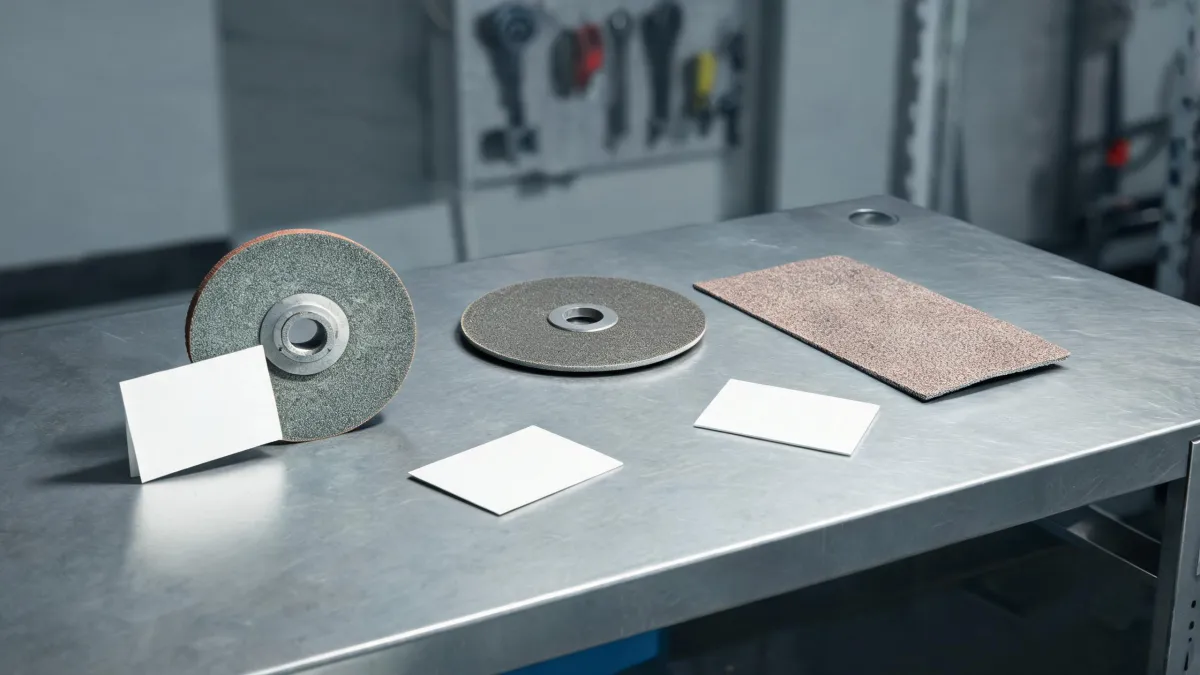
Ask five metalworkers which Norton abrasives they keep close to their 4-1/2-inch angle grinder, and you'll get five different answers. Most of them aren't wrong. They're just working in different realities.
I say that as the person who reviews every consumable before it reaches the floor at our fabrication shop. Quality/compliance manager. Roughly 200+ unique items pass through my hands every year—grinding wheels, flap discs, cut-off discs, more than a few surprises. When I started this role I genuinely expected to find one best setup. Four years in, I'm convinced the “best” is a myth. What matters is matching the abrasive to the work pattern.
Most buyers focus on price and grit and completely miss the third factor: consistency. The question everyone asks is “which Norton product is best?” The question they should ask is “which product can I rely on to behave the same way, wheel after wheel, batch after batch?” The answer depends on which of three scenarios you're living in.
The three setups I see every week
Scenario 1: You live out of a wheeled tool box
This is the mobile repair tech, the field service welder, the person who rolls into a customer's plant and needs to be done before lunch. Your 4-1/2-inch angle grinder is your workhorse, and your stockroom is whatever fits in the drawers of your wheeled tool box.
My advice for this scenario: don't over-specialize. If you carry eight types of wheels, you'll actually use two and haul around eight. Our mobile guys run a general-purpose Norton grinding wheel plus a flap disc for blending. That covers 80% of field calls. (Should mention: the flap disc rides in a hard case inside the tool box—they're more fragile than people expect, and nobody wants to open a drawer full of dust and shards.)
Look, I get the temptation to fill that box with cheap bulk wheels. I've watched what they do on a customer's site: inconsistent thickness, vibration you can feel through the handle, wheel wear that doubles the time on each joint. When you're on-site, time is money. A $3 wheel that forces a redo costs more than a $6 wheel that doesn't. To be fair, cheap wheels often test fine for the first half-hour. It's hour three when they start to fight back.
One more thing about the box itself. Most people buy a wheeled tool box based on how many drawers they can fill, not on whether the layout matches the job. I overbought a large rolling cabinet once—can't recall the exact model, and honestly I'd rather not—and spent two weekends reorganizing it before accepting the truth. A compact stack with a dedicated abrasive drawer beats a giant box where everything settles to the bottom.
Scenario 2: You grind the same joint until it's boring
If you're on a production floor welding and grinding the same assembly 60 times a week, consistency is everything. This is where we standardized on the Norton Abrasives F240 line and, frankly, stopped entertaining alternatives.
Here's what happened. During our Q1 2024 quality audit, we tracked a rework rate I wasn't happy with. The root cause kept pointing back to wheels that changed behavior from batch to batch—we were sourcing from several suppliers at the time. The spreadsheet said to switch our volume to a cheaper option, 15% below what we were paying Norton. Part of why we stuck with Norton anyway has to do with the corporate side: Norton is a Saint-Gobain brand, and for our audit trail, documented specs and batch traceability matter almost as much as the wheel itself.
Still, the data was tempting. I nearly approved the switch. Every cost analysis pointed to the budget option, and something felt off—their responsiveness had been slow, but that's not a defect. I told myself I was being old-fashioned. Then we ran a blind trial with our welders: same joint, same machine, alternating wheels.
It wasn't close. The cheaper wheels looked fine out of the box, but by the end of a shift they chattered. Thickness variance meant the operators had to adjust their angle mid-pass, which created exactly the rework we were chasing. We rejected that batch on spec grounds, kept the F240s, and watched the rework number drop the next quarter. Even after that, I spent two weeks second-guessing the decision. What if the next F240 lot arrived with its own quirks? Didn't relax until the next delivery ran as smoothly as the sample.
What I mean by “predictability” is this: with the F240 line, wheel number 500 behaves like wheel number 1. That consistency is worth the per-piece difference in our costings. I should add that no wheel saves you from a worn-out tool—we retired two beat-up angle grinders during that audit and the improvement from that alone was significant.
Also, and this is the part nobody warns you about: don't store loose wheels stacked on a concrete floor. We lost a stack worth maybe $800 when a pallet toppled in our storage area. I still kick myself for not installing a simple divider rack sooner. If I'd done it earlier, that $60 fix would have saved the whole batch.
Scenario 3: You're chasing a seamless finish
This is custom fabrication—stainless handrails, architectural details, anything where the weld seam has to disappear. Here's the counterintuitive part: if you're thinking about getting a metal laser welding machine because you think it will eliminate your grinding, it won't. It changes the grinding, but it doesn't remove it.
A laser welder dramatically reduces cleanup compared to MIG or stick—that part is real. But on stainless and aluminum, you still get a heat-affected zone that needs to be blended, especially for visible work. When we evaluated a laser system last year, our time studies showed fifteen to twenty minutes of abrasive finishing for every hour of laser welding. I was skeptical of our own numbers at first, but the trial confirmed them.
The adjustment here is toward finer work: more flap discs, less aggressive grits, a deliberate deburring step. A standard grinding wheel on a fresh laser seam is like using a sledgehammer to smooth concrete—it will do the job, but it ruins the point. We changed our Norton order mix for the finishing cell toward finer flap discs and polishing products. Oh, and we initially forgot to budget abrasives for the laser-adjacent work entirely. That was an embarrassing line item to reinstate.
“Where can I find a metal laser welding machine?” I hear that one a lot. My honest answer: start with the seam requirement, not the machine. If you're chasing cosmetic welds on customer-facing pieces, the laser is a legitimate investment. If you're hoping it will fix weld defects, the root cause is probably in your prep—and prep starts with a clean, consistent bevel from good grinding. A $200 grinder setup with the right Norton wheels prevents more defects than a six-figure laser fixes.
How to tell which scenario you're in
Three questions, and be honest with yourself:
Where does the grinding happen? If more than half of it happens at customer sites, you're in Scenario 1. Your equipment needs to carry itself.
How repetitive is the work? If you can set up one grinder and leave it all week, you're in Scenario 2. Optimize for consistency and don't let short-term price win the decision.
What does the customer actually notice? If it's delivery time, reliability wins. If it's the look of the seam, finishing wins. If it's cost per part, consistency wins—because rework is the most expensive thing you can ship. At least, that's been my experience across the projects we've reviewed.
Bottom line
There is no universal “best” Norton abrasives setup, and anyone who tells you otherwise is selling you their own situation. Whether you're rolling in with a wheeled tool box, standardizing a production line on the F240, or tuning your finishing process around a laser weld, the principle is the same: pick the product for the pattern, then verify it holds up beyond the first hour. Everything else is just preference.

Maren Jorgensen
Maren Jorgensen is an independent hand tool and torque applications analyst covering wrenches, pliers, screwdrivers, hammers, sockets, ratchets, hex keys, and tool sets. She applies ISO 6789-1 torque-tool conformance principles while examining jaw capacity, leverage, fastener engagement, torque range, accuracy, handle geometry, and material hardness. Her practical guides help tradespeople and procurement teams select suitable tools, plan controlled tightening, and compare durability without relying on brand reputation alone.