-
The Day I Found Out the Hard Way
-
Why I Thought It Would Work
-
The First 30 Seconds Were Suspiciously Fine
-
The Smell Is Stronger Than the Lesson
-
So, Can You Use an Angle Grinder as a Polisher?
-
Norton Abrasives (Saint-Gobain) Diamond Flexible Pads: Quick Overview
-
Buying From Norton Abrasives Distributors Makes a Difference
-
A Quick Note on Speed Ratings and Safety
-
The Checklist I Use Now
The Day I Found Out the Hard Way
It started on a Tuesday in September 2022. I had a concrete countertop to polish, a brand-new box of Norton Abrasives diamond flexible pads, and my Makita G13SC2M angle grinder sitting on the bench. If you've ever asked yourself, 'can I use an angle grinder as a polisher?' this story is for you. The short version: I did it, and it didn't go according to plan. The longer version involves a $40 pad, a burnt smell, and a very pointed look from my foreman.
I'm not a total beginner, either. I've been handling tool and abrasive orders for a small fabrication shop for six years. I've personally made (and documented) 14 significant mistakes, totaling roughly $6,000 in wasted budget. Now I maintain our team's checklist so the newer guys don't repeat my errors. This one was entirely my fault, and I still kick myself for it.
Why I Thought It Would Work
If you hold an angle grinder next to a polisher, they basically look the same. Both spin a disc. Both use an abrasive. My grinder was even the right size—a Makita G13SC2M with a 4-1/2 inch guard. I figured, honestly, that the only difference was the pad I attached.
What I didn't think about was speed. The G13SC2M is a fixed-speed grinder. It's designed for cutting and grinding, not slow, controlled polishing. Most people don't realize that flexible diamond pads aren't grinding discs. They're resin-bonded pads on a flexible backing. At high rpm, that resin gets hot. Really hot. And when that happens, the pad stops polishing and starts baking itself into the surface.
In hindsight, I knew I should have checked the Norton data sheet before starting. But I thought, 'What are the odds?' Well, the odds caught up with me in about two minutes.
The First 30 Seconds Were Suspiciously Fine
I put on the first Norton diamond pad (the coarse grit one), started the grinder, and pressed it against the countertop. For about half a minute, it looked like a win. The pad was cutting. The concrete was leveling out. I actually started thinking, 'Why did everyone tell me to buy a polisher?'
Then the pad started to chatter. I backed off, checked the pad, and the edge looked like it was rolling under. I went to turn the grinder down—except I couldn't, because it's a fixed-speed angle grinder. It has one speed. That was the exact moment my confident plan started to fall apart.
Here's something vendors won't tell you: flexible diamond pads have a maximum operating speed, and it's much lower than the average angle grinder speed. Norton's published specs for its diamond flexible pads recommend staying well below 11,000 rpm. My grinder runs around there. I didn't check. I just assumed a pad is a pad, and that was the first mistake.
The Smell Is Stronger Than the Lesson
I kept going. I know—you can see where this is headed. The chatter got worse, and then I smelled it: that sharp, acrid smell of resin breaking down. I lifted the grinder and looked at the pad. It had started to separate from the velcro backing. On one edge, the diamond coating was peeling off like a piece of burnt toast. I honestly wanted to blame the pad. Then I looked at the concrete. There was a dull, scorched spot in the middle of the countertop.
That spot took me two hours to fix. The countertop had a sealer that needed to be stripped and reapplied, so the damage went far beyond the pad. I spent $40 on a replacement pad, but the real cost was the re-polishing time, the wasted material, and the fact that my foreman walked in while I was trying to figure out how to hide it. He didn't even need to say anything. I have never felt more like a person who ignores small problems until they become big ones.
Funny side note: while I was digging through my tool box looking for a spare backing pad, one of the tool box caster wheels finally gave out. It had been wobbly for weeks. Replacing the tool box caster wheels took less time than fixing the countertop, but it was the same story: I saw a sign, ignored it, and paid for it later. Some days teach you the same lesson twice.
So, Can You Use an Angle Grinder as a Polisher?
Not the way I did it. Here's the honest answer: yes, you can use an angle grinder as a polisher, but only if it has variable speed and you set it to match the pad. The 'grinder is a polisher' thinking comes from an era when people used rigid felt wheels and polishing compounds. Today's Norton diamond flexible pads are a different animal. They're designed for controlled, lower-speed work—usually in the 2,000 to 4,500 rpm range, depending on the pad, the material, and whether you're working wet or dry. Running one at full grinder speed is not just inefficient; it can damage the pad and the workpiece.
The fundamentals haven't changed: you match the abrasive to the material and the job. What has changed is the tooling. A variable-speed grinder or a dedicated polisher is the right tool. If you only have a fixed-speed angle grinder at 11,000 rpm, don't force it. Borrow a polisher, rent one, or pick up a variable-speed model. The cost of the right tool is a fraction of the cost of a ruined project.
Norton Abrasives (Saint-Gobain) Diamond Flexible Pads: Quick Overview
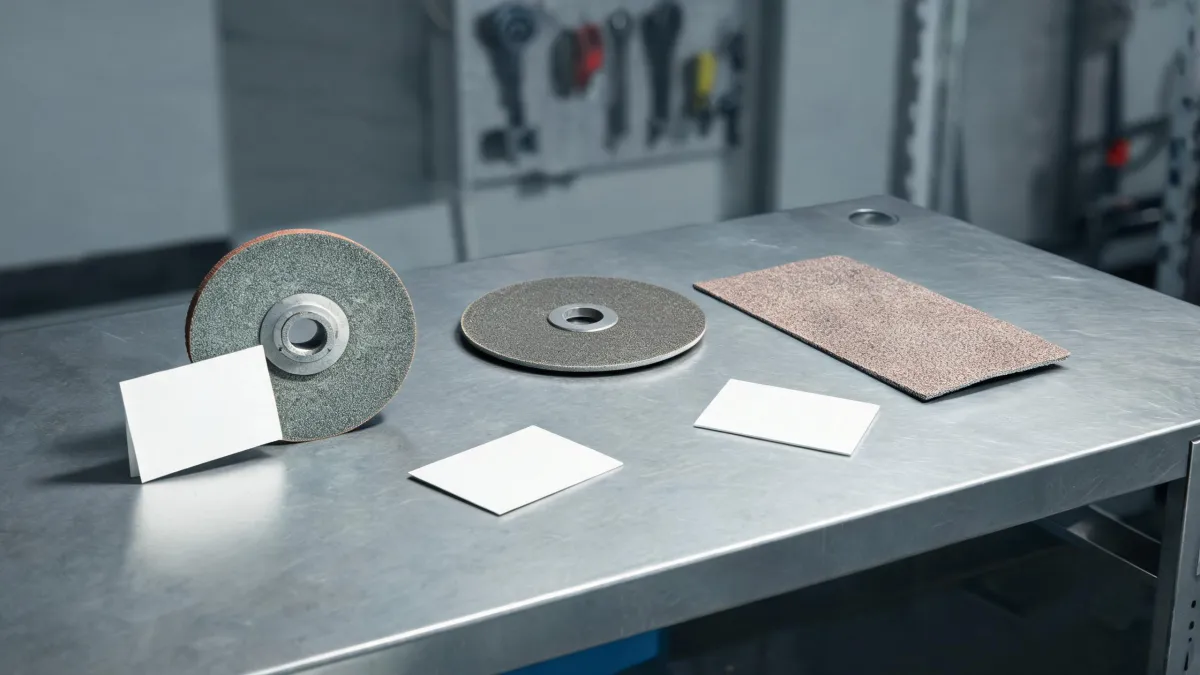
For anyone who hasn't used them: Norton Abrasives is part of the Saint-Gobain group, and their diamond flexible pad line is one of the most useful things you can put in a stone or concrete shop. These aren't grinding discs. They're flexible, diamond-bearing pads for polishing granite, marble, concrete, and engineered stone—typically in a sequence from coarse to fine (around 50 grit all the way up to 3000 grit). You use them wet on stone, and sometimes dry on concrete with a dust extractor. They're fairly friendly to use, as long as you respect the speed limit.
Buying From Norton Abrasives Distributors Makes a Difference
I bought my pads online, but not from an authorized Norton Abrasives distributor. I can't say for sure the listing was a counterfeit—I honestly don't know. What I do know is that the package had no technical data sheet, and the product page didn't mention max speed. When I later looked up the same product on a legitimate Norton Abrasives distributor's site, the specs were right there in plain text. If I had seen that page before I started, I would have known my angle grinder was wrong.
Here's something that surprised me: after my failure, I called a local Norton Abrasives distributor and asked about the proper setup. They walked me through the grit sequence, the backing plate, and the speed range. It took ten minutes, and it stopped me from making the same mistake twice. If you're buying diamond flexible pads for the first time, don't just add them to your cart. Ask a distributor. It's free, and it works.
A Quick Note on Speed Ratings and Safety
There's an actual standard behind this, not just my bad day. ANSI B7.1, the safety standard for abrasive wheels, requires that abrasive products not be used above their marked maximum operating speed. OSHA has similar requirements for grinding machines. That's not bureaucracy; it's because the bond holding the abrasive together can fail faster than you think if you spin it too fast. The same logic applies to flexible diamond pads. Before using any Norton pad, read the data sheet. If there's no stated max speed, that's a red flag.
The Checklist I Use Now
I keep a simple pre-polishing checklist in the shop now. It's not complicated:
- Use a variable-speed tool. If the grinder can't slow down, it's not a polisher.
- Use the right backing plate for the pad.
- Follow the grit sequence. Skipping grits usually means redoing the job.
- Check the manufacturer's data sheet for maximum RPM. If there's no data sheet, that's your answer.
The last bullet is the one I ignored. It cost me a pad, a scorched countertop, and half a day. The good news is that the lesson stuck. I haven't tried to polish with a fixed-speed angle grinder since. Bottom line: if you have a Makita G13SC2M or any fixed-speed angle grinder and you're wondering whether you can use it as a polisher—save yourself the headache. It's not the right tool, and the Norton pads will tell you that, too, usually at the worst possible moment.

Maren Jorgensen
Maren Jorgensen is an independent hand tool and torque applications analyst covering wrenches, pliers, screwdrivers, hammers, sockets, ratchets, hex keys, and tool sets. She applies ISO 6789-1 torque-tool conformance principles while examining jaw capacity, leverage, fastener engagement, torque range, accuracy, handle geometry, and material hardness. Her practical guides help tradespeople and procurement teams select suitable tools, plan controlled tightening, and compare durability without relying on brand reputation alone.