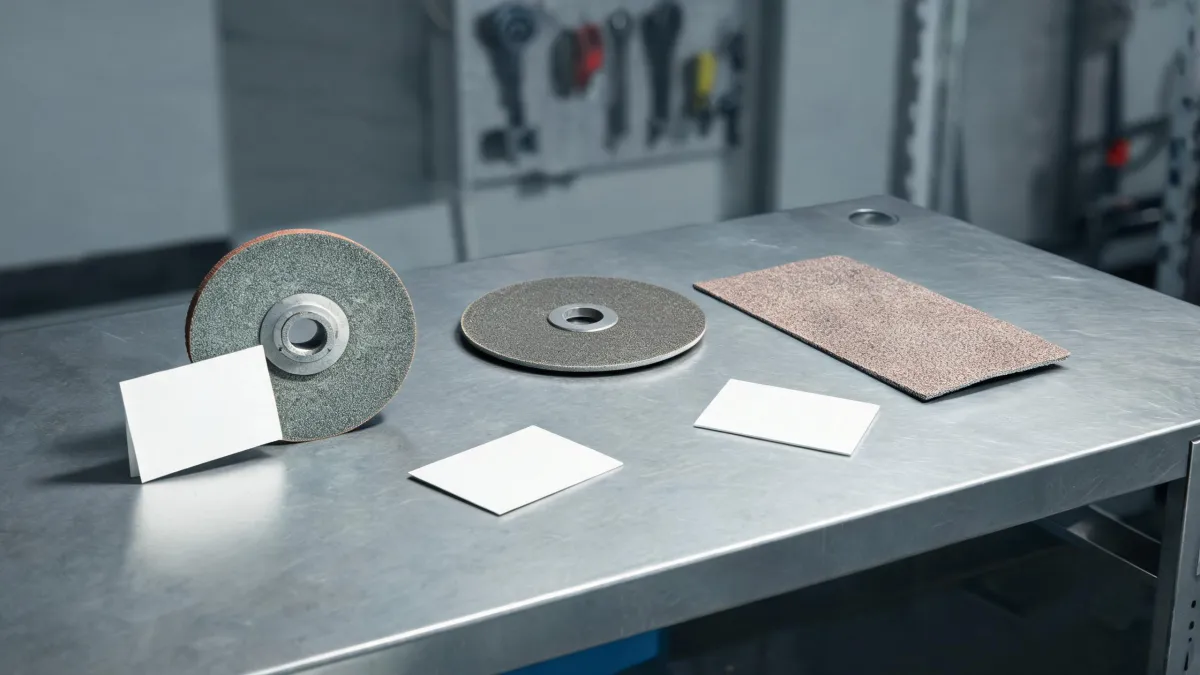
If you've ever searched for “grinding wheels” and ended up staring at a page of product numbers that all look the same, you know the feeling. Maybe you need to sharpen a knife. Maybe you need to replace a worn wheel on a 4-1/2” grinder. Either way, you end up in the same place: hovering over the Norton Abrasives section of an online store, wondering whether you're about to buy the wrong thing.
I'm a quality and brand compliance manager in the abrasives industry. I review the products before they reach customers—roughly 200+ unique items every year. I've rejected deliveries that didn't match spec, measured more wheel diameters than I can count, and spent more hours than I care to admit comparing manufacturer markings against ANSI B7.1. Trust me on this one: most grinding wheel problems are not wheel problems at all. They're selection problems. And the fix is simpler than you think.
The surface problem: “Which model number do I need?”
The first trap is believing the problem is the part number. If you've been searching for “grinding wheel 71897” hoping it's a magic answer—you're not alone. That number shows up constantly in distributor inventories. It's one of those Norton catalog numbers that appears in pretty much every stock feed, and it sits in the same visual family as dozens of other wheels that all look identical in a thumbnail.
What most people don't realize is that a part number isn't the answer. It's a fingerprint. The catalog entry tells you the diameter, thickness, arbor size, grit, and—most importantly—the maximum operating speed. That last number is the one everyone skips. It's also the one that gets people into trouble.
So you pick a wheel that fits the arbor and hope for the best. It arrives, you mount it, and one of three things happens: it glazes over and stops cutting, it grinds too hot, or it works just fine until the day it doesn't.
The deeper problem: nobody told you how abrasives actually work
Here's the thing: a grinding wheel is not a single product. It's a recipe with several ingredients—the abrasive grain, the grit size, the hardness grade, the bond, and the reinforcement that determines the speed rating. Change one of those and you have a completely different tool.
When someone asks a distributor for “a Norton grinding wheel” without saying what material they're cutting or what machine they're using, the distributor is guessing. To be fair, most of them are doing their best with what they've been given. But a guess is still a guess, and the invoice won't tell you it was a guess until the wheel fails.
And here's the part that gets ignored: the Norton abrasives catalog is fairly well organized. The problem is that most people read it like a menu, not like a spec sheet. What I mean is that a menu asks what you're hungry for, while a spec sheet asks what's in front of you—the material, the machine, the speed, the finish you need. Skip those questions, and every wheel you buy is a roll of the dice.
Real talk: the people answering the phones at grinding wheel suppliers range from application engineers to pure order-takers, and the difference shows up in the first twenty seconds. If the first question you get is “what are you cutting, and on what machine?”—you're in good hands. If you get “how many do you want?”—keep shopping. That's true for any brand, Norton included.
Then there's the knife question.
“How to sharpen a knife on a grinding wheel” is one of those searches that makes me wince, because the internet will gladly show you a man pressing a blade against a spinning wheel until the sparks fly. What it won't tell you is that a coarse grinding wheel is the fastest way to ruin a knife that exists outside of a bench vice. Overheating the edge destroys the temper—the heat treatment that keeps the steel hard. Once that edge changes color, it's gone forever. That $160 chef's knife is now a very sharp-looking letter opener.
The cost of getting it wrong
The risk isn't just a wasted $18 wheel. It's downtime, rework, ruined material—and sometimes an injury.
In my role, I've personally reviewed cases where the maximum RPM rating was ignored. Running a wheel faster than its rated speed is how wheels come apart. ANSI B7.1 has been clear for decades: the wheel's operating speed must match the grinder. OSHA 29 CFR 1910.215 says essentially the same thing. Every wheel I approve has a speed rating marked on it, and I've rejected entire batches when that marking was off.
That's not a theoretical concern. In Q1 2024, we received a batch of 8,000 wheels where the reinforcement didn't match the label. Normal tolerance, since we implemented our verification protocol in 2022, is test-every-batch. The vendor called it “industry standard.” We called the shipment rejected. That quality issue cost us about $22,000 in redo labor and pushed our launch back by three weeks. The vendor redid the batch at their cost, and the contract now includes third-party testing.
But the cost isn't only safety. It's productivity. Pick a wheel that's too hard for your material and it glazes over—you're not grinding, you're polishing the air. Pick one that's too soft and it disappears in minutes. Either way, the real cost is time. Plus, there's the small matter of the workpiece that gets burned or gouged in the process.
And small buyers eat the worst of it, because they don't have a tooling engineer to call. If you're ordering one wheel for a weekend job, you are the tooling engineer. If you're a shop running a trial order of 25 Norton abrasives products, you're the one holding the cost when the spec was wrong.
Here's something vendors won't tell you: the salesperson's job ends when the invoice is sent. The only person who lives with a bad wheel choice is you.
Even after I picked a new supplier for a trial order, I kept second-guessing. What if their quality wasn't as good as the samples? The two weeks between order confirmation and delivery were stressful. It worked out—but that uncertainty is exactly what you're paying to avoid. It's also why good suppliers, Norton abrasives distributors included, spend five extra minutes qualifying the application before they quote.
The fix: stop shopping by number, start shopping by question
So what do you actually do? The fix is almost boringly simple.
First, read the spec lines, not the marketing copy. Whatever wheel you're considering—the 71897 or its neighbor on the Norton abrasives catalog page—check three things: the maximum RPM against your tool's no-load speed, the arbor size, and the grit. For grinding steel, 36-grit removes material fast and rough; 60-grit is the general middle ground; 120-grit is finishing. Your material and your finish decide the grit, not the other way around.
Granted, this takes two extra minutes. In four years of reviewing products, I've never once seen that time wasted.
Second, work with a Norton abrasives distributor who asks questions. Send them the material, the tool, the RPM, and the finish you need. If they come back with a recommendation that includes a part number—great, now you've got one with reasoning behind it. If they come back with a price only, treat the recommendation as what it is: a guess.
How to sharpen a knife on a grinding wheel (the way that doesn't ruin it)
It can be done. It just isn't done the way the videos show it.
- Use a fine wheel—180 grit or finer. The coarse 36-grit wheel that's perfect for weld dressing is the worst thing you can put near a blade.
- Keep the edge cool. Two or three seconds on the wheel, then dip it in water. If the steel starts to blue, the temper is gone—stop immediately.
- Light pressure, steady sweep, and keep the bevel angle consistent. You're aiming for a whisper of a grind, not a shower of sparks.
- Finish with a honing steel to knock off the burr. That's where the actual sharpness comes from.
And if your order is small—a single wheel, a few flap discs, or a knife-on-a-grinder question—find a supplier who still treats it like a real order. In my opinion, the test of a supplier isn't how they handle a 50,000-unit annual order. It's how they handle the $40 order from someone trying to learn. Today's small order is tomorrow's account. Good suppliers know that.
Bottom line: the right grinding wheel was never the hard part. The hard part is admitting what you don't know about your own job—material, speed, finish—and finding someone worth asking. That's the first thing I check before a product goes out the door, and the first thing you should check before it goes on your grinder.

Maren Jorgensen
Maren Jorgensen is an independent hand tool and torque applications analyst covering wrenches, pliers, screwdrivers, hammers, sockets, ratchets, hex keys, and tool sets. She applies ISO 6789-1 torque-tool conformance principles while examining jaw capacity, leverage, fastener engagement, torque range, accuracy, handle geometry, and material hardness. Her practical guides help tradespeople and procurement teams select suitable tools, plan controlled tightening, and compare durability without relying on brand reputation alone.