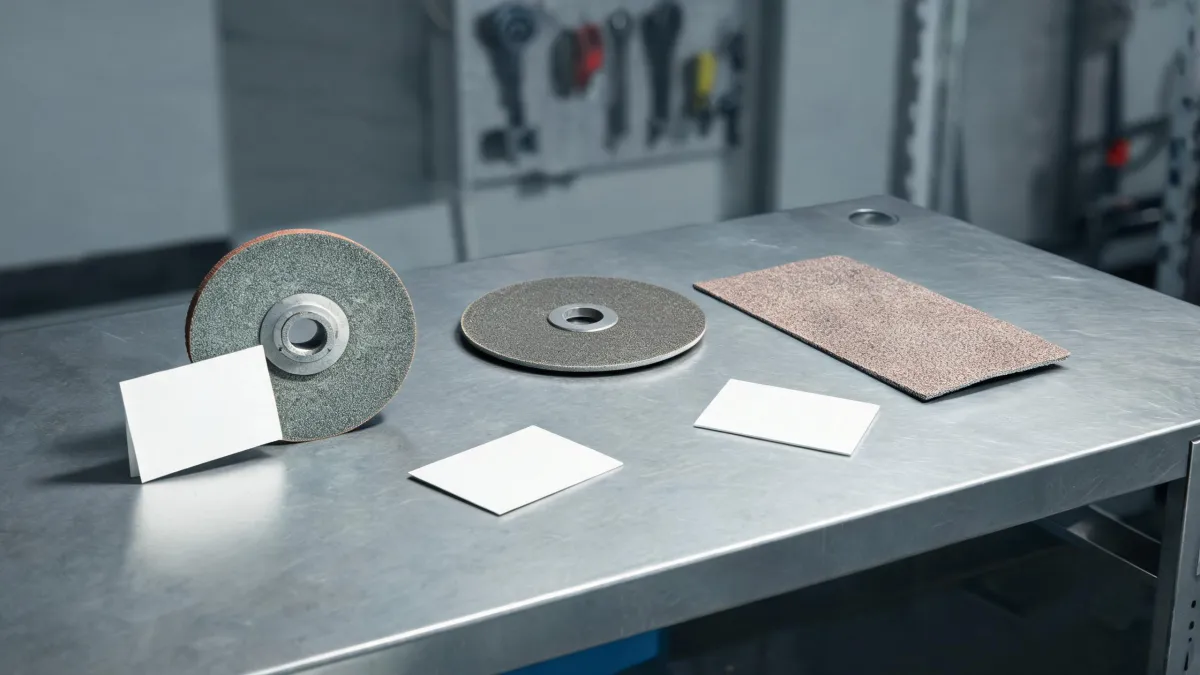
If you’ve ever stared at a Norton Abrasives catalog and felt your eyes glaze over, you’re not alone. I’m a quality and compliance manager at a mid-size tool manufacturer. I review every grinding wheel spec before it reaches our production floor—roughly 200 unique wheels a year. I’ve rejected about 15% of first deliveries in 2024 due to incorrect markings or max speed mismatches. One question I keep hearing from our operators and from other shops: “Should we switch to CBN grinding wheels, or stick with the traditional aluminum oxide ones?” I’ve been through this decision, and I’ll walk you through the same comparison I ran in my own plant. Fair warning: the answer isn’t a one-size-fits-all.
What You’re Actually Comparing
On one side, you have a conventional wheel like the Norton Abrasives 38A220-HVBE. That’s a Type 1—flat, straight, classic. It’s a white aluminum oxide wheel with a 220 grit, vitrified bond. According to Norton Abrasives (nortonabrasives.com, accessed January 2025), this is a premium fused alumina abrasive used for surface and cylindrical grinding. On the other side, you have a CBN grinding wheel—cubic boron nitride, a superabrasive. If you’ve been wondering “what is CBN grinding wheel” in plain English: it’s a wheel with tiny, extremely hard CBN grains, usually on a metal or resin bond. It grinds ferrous materials fast and holds form well.
The catch? CBN wheels are expensive. I went back and forth between switching our toolroom over to CBN and sticking with conventional wheels for two weeks. On paper, CBN looked like the future. But my gut said a $300 wheel that you might accidentally drop is a hard sell in a busy shop. So I set up a quick side-by-side test. Actually, we ran a three-month trial on 50,000 parts.
Cost Per Part vs. Upfront Price
Let’s get the elephant out of the room: price. The Norton 38A220-HVBE might cost you somewhere in the range of $20 to $40, depending on size, plus freight. A similar CBN wheel? I got quotes from $250 to $700. That’s a 10x difference up front. But that’s not the metric that pays the bills.
Over that three-month trial, our conventional wheel required dressing every 40-60 parts and had to be replaced twice. The CBN wheel ran the entire time and needed almost zero dressing. When I calculated cost per part—including labor for dressings, downtime, and scrap—the CBN wheel actually came out about 23% cheaper on that high-volume hardened steel job.
But here’s the part that surprises people: for our low-volume toolroom jobs, the conventional wheel was still the winner. If you grind 10 parts and then the wheel sits for a week, the CBN advantage evaporates. You’re paying a premium for performance you’re not using. My rule of thumb: if a job runs under 100 parts, stick with conventional. If it’s thousands of identical parts, CBN is often worth the sticker shock.
Bottom line: the most expensive wheel is not necessarily the most expensive. The wheel that causes less downtime—that’s where the savings hide. (Source: our Q3 2024 cost analysis, internal data.)
Material Compatibility: The Counterintuitive Part
Conventional wisdom would tell you CBN is the superior abrasive, so it must be better on everything. Not true. CBN is fantastic on hardened steels, high-speed steel, and nickel alloys. But if you try to grind softer, non-ferrous materials—aluminum, brass, or even mild steel with lots of free ferrite—the CBN wheel can load up. The aluminum literally melts and sticks to the bond.
The Norton 38A220-HVBE, on the other hand, is pretty forgiving. We’ve used it on everything from tool steel to stainless to aluminum. It wears faster, sure, but it doesn’t load. So if your shop runs a mix of materials, a conventional wheel is a safe default. That’s a point people on the CBN hype train don’t like to admit.
(Should mention: we also tested a Norton BlueFire ceramic wheel in between—that one handles both pretty well, but it’s a third option and not the topic today. Maybe I’ll save that for another post.)
Surface Finish and Wheel Wear
For our surface grinding operations, finish matters as much as material removal. The 220 grit wheel gives a fine finish—we’ve measured Ra around 0.3-0.5 microns on a good day. CBN wheels can do better and, more importantly, do it consistently. A CBN wheel wears slowly, so the wheel profile stays true for a long time. That means you can rely on the same part geometry across a long run.
That said, the finish difference on a low-carbon steel is barely noticeable. I ran a blind test with our QC team: parts ground with the conventional wheel vs. CBN, both finalized at the same grade. Our inspector could not consistently tell them apart without measuring. We had to break out the profilometer to see the difference. So if you’re chasing microns, CBN matters. If you just need a “good enough” finish, save your money.
To be honest, I was surprised by this. I’m not 100% sure why—maybe because the 220 grit is already fine enough. Take this with a grain of salt, because it’s only one test with one wheel spec. However, it changed how I quote for customer requirements. I still kick myself for not running this test years earlier; it would have saved us from over-specifying on at least one project.
Practical Stuff: Equipment, Storage, and a Big-Wheeled Toolbox
CBN wheels are not plug-and-play. They need a rigid machine, a high spindle speed, and usually a coolant system. Running a CBN wheel on an old surface grinder with vibration or low rpm can cause chatter and, worse, wheel damage. The Norton 38A is more forgiving—it’s fine on manual grinders and CNC alike.
Also, think about handling. CBN wheels are heavy and fragile if dropped. We store them vertically in a padded rack. We also bought a tool box with big wheels to move wheels and accessories around the shop. Honestly, that was a game-changer. I used to carry wheels one at a time and almost dropped a $600 CBN wheel on day one. That would have been a painful regret. It wasn’t about the abrasives themselves, but about moving them safely. A big-wheeled tool box—or at least a sturdy cart—pays for itself.
And don’t forget to check your spindle speed against the wheel’s max rpm. Per ANSI B7.1 (as of January 2025), you must always run a wheel at or below its published maximum operating speed. No—wait—actually you must never exceed the maximum. That’s the rule. Missing that is a red flag on any safety audit.
How to Read a Grinding Wheel Chart
If you’re looking at the Norton Abrasives catalog and see something like “38A220-HVBE,” it’s a code. A grinding wheels chart translates it like this:
- 38A = abrasive type (white fused alumina)
- 220 = grit size (medium-fine)
- H = hardness grade (soft to medium)
- V = bond type (vitrified)
- BE = bond modification or manufacturer-specific suffix
That’s basically the standard ANSI marking system. If you see a Norton Abrasives grinding wheel T1 (Type 1), it means flat and straight—used for surface or cylindrical grinding. The chart is your friend. I keep one laminated near the wheel rack. It’s saved me from ordering the wrong spec more than once.
So Which Should You Buy?
If you’re grinding hardened steel in high volumes, especially with tight tolerance and high repeatability—choose CBN. Accept the upfront cost. It’s a no-brainer on cost per part.
If your work is varied, low-volume, or includes soft/non-ferrous materials—stay with conventional wheels like the Norton 38A series. You’ll save money and avoid headaches. The T1 shape is perfect for most basic grinding tasks.
And if you’re on the fence, do what I did: run a 30-day side-by-side trial. Track dressing time, wheel life, scrap, and labor. Let the numbers decide. That’s the value-over-price approach—you’re not buying a price, you’re buying a result. I have mixed feelings about CBN—on one hand, it’s the future of abrasives; on the other, it’s not the answer for every shop. But that’s the honest answer, and it’s the one that will save you money in the long run.

Maren Jorgensen
Maren Jorgensen is an independent hand tool and torque applications analyst covering wrenches, pliers, screwdrivers, hammers, sockets, ratchets, hex keys, and tool sets. She applies ISO 6789-1 torque-tool conformance principles while examining jaw capacity, leverage, fastener engagement, torque range, accuracy, handle geometry, and material hardness. Her practical guides help tradespeople and procurement teams select suitable tools, plan controlled tightening, and compare durability without relying on brand reputation alone.