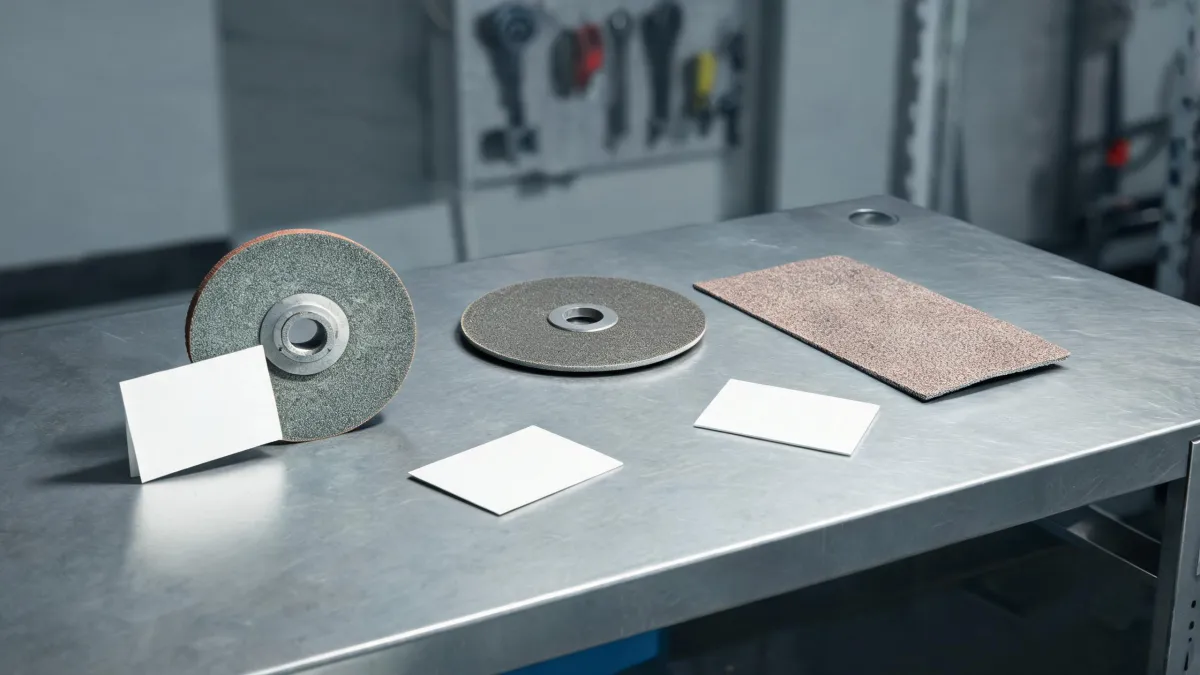
There is no single "right" way to use an angle grinder. Seriously. The right technique depends on what you're cutting, what you're grinding, and the material under the disc. I've spent eight years sourcing abrasives for a metal fabrication shop, and I've personally documented 14 significant mistakes—some of which cost more than $1,000 in rework. So I'll give you the same advice I now give our crew: start with the right product category on the Norton abrasives line, then worry about speed, pressure, and angle.
If you're searching for "how to properly use an angle grinder," you're probably facing one of these three scenarios:
- Cutting metal or stainless steel
- Grinding welds or removing surface material
- Concrete work or prep before chemical anchoring
The product you need is different for each. That's why a cut-off wheel and a grinding wheel are not interchangeable—and why "universal" is a word I don't trust.
In 2017, I ordered 300 cut-off wheels for a project that was mostly weld grinding. The spec sheet looked right on my screen. The first operator told me the problem in two minutes: "These are for cutting, not grinding." That $1,900 order ended up as scrap. It changed how I look at every abrasive order (note to self: always ask what action the operator is performing).
Scenario A: Cutting Metal and Stainless Steel
If you need to part steel, cut through bolt, trim rebar, or make a clean slot, you're in cut-off territory. This is where Norton Abrasives Gemini RightCut belongs. I use it for fast, clean cuts on carbon steel and stainless. The name actually tells you the intent: right cut, meaning the wheel is designed for cutting action, not heavy side pressure.
Proper technique for this scenario is simple: let the wheel do the work, keep the blade perpendicular, and don't twist the grinder. If you feel grab or smoke, back off. Forcing a cut-off wheel is the fastest way to break it—and a broken wheel at 9,000 RPM is a red flag no one wants to deal with.
Another important item: check the RPM rating on the wheel. ANSI B7.1 treats this as a safety requirement, and every Norton wheel I've seen lists the maximum RPM on the label. If the wheel's maximum RPM is lower than your grinder's no-load speed, it's not a matter of "it'll probably be fine." It's a safety checklist item.
A mistake that stood out: in March 2022, we had a $680 stainless fabrication job rejected because the cut face was discolored from using a wheel that had already been used on carbon steel. Looking back, I should have marked our stainless cut-off wheels separately. The grinding wheel catalog won't tell you that—it's a shop-floor habit I should have fixed earlier.
Scenario B: Grinding Welds and Removing Material
If you're smoothing a weld, removing rust, or shaping metal, a cutting wheel is the wrong tool. You need a grinding wheel. Norton Abrasives BlueFire R821P is the example I reach for when someone asks for a high-productivity grinding wheel on steel.
Here's the thing about the BlueFire R821P: it's designed for stock removal. That means it's not a finishing wheel. If you need a mirror finish, you'll move on to flap discs or finer abrasives. But if you need to knock down a weld before you even think about finish, this is the category.
How to properly use an angle grinder in grinding mode:
- Use the edge of the wheel at about a 15-30 degree angle, not the full face flat.
- Let the wheel's speed do the cutting. Push just enough to keep it in contact.
- Move in a controlled path. Waving the grinder around gives you uneven material removal.
- Keep the guard on. I know it's tempting to remove it for visibility, but the guard is the only thing between you and a wheel that can explode.
I once chose a wheel with the right grit but the wrong bond for the application. The catalog said "softer bond for harder metal," and I ignored the RPM column. The wheel wore out twice as fast. If I could redo that decision, I'd check both columns in the Norton grinding wheel catalog before committing.
Scenario C: Concrete, Masonry, and Chemical Anchor Prep
This scenario feels different because the rules change. For concrete or masonry, standard abrasive cut-off wheels are not your first choice. You should be looking at diamond blades or diamond cup wheels. The same angle grinder can work, but the "abrasive" is not the same.
And if you're doing surface prep before installing chemical anchors, please read the chemical anchor bolt catalogue before you start. I'm not being dramatic. The catalogue gives you the hole dimensions, cleaning procedure, and cure times. I'm not a structural engineer, so I can't tell you which anchor rating your job needs. But I can tell you this from a procurement perspective: the grinder is for cutting rebar or cleaning the surface, not for changing the anchor requirements.
Use an angle grinder with a diamond cup wheel to clean the concrete surface. Then switch to the drill for the actual anchor hole. The chemical anchor bolt catalogue will tell you whether the hole must be dry, brush-cleaned, and free of dust. That's not a preference, it's an installation requirement.
In November 2023, I watched a crew skip the "clean the hole" step to save time. The anchor failed a pull test two days later. That cost us a three-day delay and a very tense meeting. The catalogue had the answer from the beginning. I should have flagged it earlier.
How to Tell Which Scenario You're In
If you're still on the fence, here's the decision tree I use:
- Are you trying to separate material? → Scenario A. Get a cut-off wheel like Norton Abrasives Gemini RightCut.
- Are you trying to remove material from a surface? → Scenario B. Get a grinding wheel like Norton Abrasives BlueFire R821P.
- Are you working on concrete or preparing for chemical anchors? → Scenario C. Get a diamond blade or cup wheel, and read the chemical anchor bolt catalogue.
Still not sure? Pull up the Norton abrasives product section or the grinding wheel catalog and check the "application" column. Norton groups products by what they do—cutting, grinding, blending, finishing. If you pick the right category first, the technique is much easier to get right.
Bottom line: the best angle grinder technique in the world won't fix a wrong wheel selection. Know your scenario, check your product category, and don't let a "it should work" attitude cost you what it cost me. That's the whole point of this checklist—learn from someone who already made the mistake.

Maren Jorgensen
Maren Jorgensen is an independent hand tool and torque applications analyst covering wrenches, pliers, screwdrivers, hammers, sockets, ratchets, hex keys, and tool sets. She applies ISO 6789-1 torque-tool conformance principles while examining jaw capacity, leverage, fastener engagement, torque range, accuracy, handle geometry, and material hardness. Her practical guides help tradespeople and procurement teams select suitable tools, plan controlled tightening, and compare durability without relying on brand reputation alone.