-
Who this checklist is for
-
Step 1: Confirm arbor size and flange hardware first
-
Step 2: Match the abrasive to the material — this is where mower blades get interesting
-
Step 3: Verify max RPM against the tool's no-load RPM
-
Step 4: Confirm guard compatibility, and order guarding accessories in the same order
-
Step 5: Read the spec sheet, not the product photo
-
Step 6: Set a reorder point instead of reordering one-offs
-
Common mistakes that get expense reports rejected
Who this checklist is for
If you're the person who places MRO orders for a facility, a shop floor, or a landscaping operation with its own maintenance bay, this is for you. I'm an office administrator who took over purchasing for a 60-person company in 2020. That includes the abrasives our maintenance crew burns through every season — 4.5" angle grinder wheels, flap discs, cut-off wheels, and the guarding accessories that go with them.
My experience is based on roughly 200 abrasive orders across three locations. I've only worked with domestic distributors, so if you're sourcing internationally, your lead times and paperwork will look different from mine. But the specification checks below are the same ones our maintenance lead made me run through after my first bad order.
Here's the checklist I actually use before I click "confirm" on any grinding wheel order. Six steps. Every one of them has a checkpoint.
Step 1: Confirm arbor size and flange hardware first
Before abrasive type, before grain, before price — confirm the arbor size. A standard 4.5" angle grinder takes a 7/8" arbor. Most do. But "most" is where money gets wasted, because a wheel that doesn't sit flush on the flange is a wheel that comes back in a return box with a complaint attached.
Checkpoint: pull the actual tool spec, not the product category. If your maintenance team has mixed brands on the shop floor, get a list of the tools before you get a quote. It takes ten minutes and saves a return cycle.
The flange hardware is where I got burned in 2022. We ordered a batch of wheels that matched the arbor size but came without the backing flanges our older grinders needed. The wheels were fine. The order was useless until we ordered the flanges separately (which, honestly, no one on the quote had mentioned).
Step 2: Match the abrasive to the material — this is where mower blades get interesting
"What grinding wheel for mower blades" is one of the most common search terms I see in the maintenance requests that land in my inbox. The answer depends on the blade steel, but for typical hardened carbon steel blades, a 24- or 36-grit aluminum oxide wheel on a 4.5" angle grinder handles the rough work. You follow up with something finer if the maintenance lead wants a finished edge.
This is where the Norton abrasives catalog becomes useful, and also where people get sloppy. Spec lines like the Norton Gemini 57A show up in sharpening recommendations online, but that spec was written for a specific machine type and duty cycle. If someone recommends it to you for a mower blade, ask them which tool they used it on. Bench grinder and angle grinder wheels are not interchangeable, and the safety requirements behind them are not the same either.
Checkpoint: confirm the wheel's intended application (metal, masonry, stainless) matches the material your crew is actually grinding. Mixing a stainless-rated wheel into a carbon steel job is a waste of a premium; the reverse can be a contamination problem.
Step 3: Verify max RPM against the tool's no-load RPM
This is the step people skip, and it's the one that gets people hurt. Every grinding wheel has a maximum rated RPM stamped on the blotter. Every grinder has a no-load RPM printed on the nameplate. The wheel's max RPM must be equal to or higher than the tool's no-load RPM. Not "close enough." Not "probably fine."
According to ANSI B7.1 (Safety Requirements for the Use, Care, and Protection of Abrasive Wheels), using a wheel beyond its rated speed can cause catastrophic failure. OSHA 29 CFR 1910.242 also covers portable grinder safety, but ANSI B7.1 is where the wheel-specific numbers live. If your supplier can't give you a wheel's max RPM in writing, that's your signal to find another supplier.
Checkpoint: for every SKU on the quote, the max RPM should be listed. If it isn't, ask. If the answer is vague, walk.
Step 4: Confirm guard compatibility, and order guarding accessories in the same order
Here's the part that surprised me when I first took over purchasing: guarding isn't an accessory. It's a requirement. A 4.5" wheel needs a guard sized for that diameter, and if you're buying replacements for a grinder that came with an adjustable guard, the guard needs to be adjusted, not removed.
Looking back, I should have ordered the guarding accessories with the first batch of wheels in 2021. Instead, I bought wheels, the wheels arrived, maintenance installed them, and then I got a request three days later for guarding parts I hadn't budgeted for. If you're sourcing from a Nordic or EU distributor, these sometimes show up under catalog terms like afdækning tilbehør. Don't assume it means something else — it's the guarding accessory line, and it's worth including in the same PO.
Checkpoint: for every wheel in the cart, confirm the guard that's currently on the tool accepts that wheel diameter. If not, order the right guard in the same order.
Step 5: Read the spec sheet, not the product photo
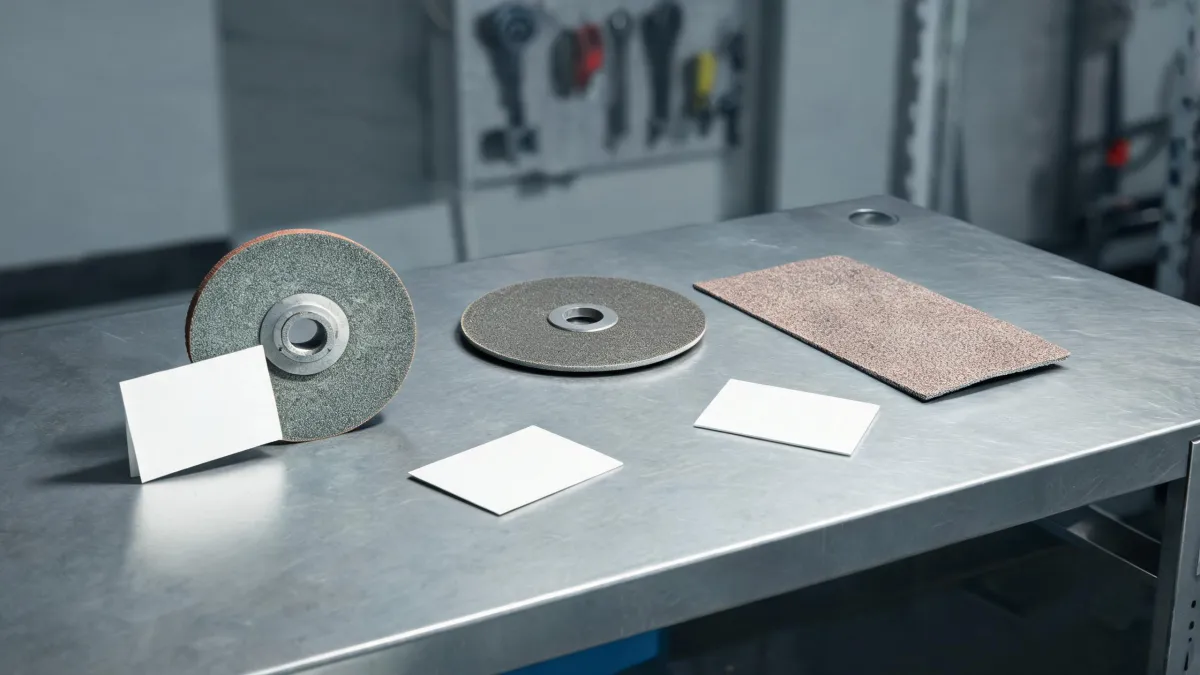
From the outside, two wheels on a distributor page can look identical. Same diameter, same thickness, same arbor. The reality is that the grain, bond, and rated application can be completely different, and the photo won't tell you any of it.
This is where "tool box wheels" becomes a trap. Small wheels sold in mixed tool-box kits are often lower-rated for intermittent use and lighter duty. If a maintenance tech requests a tool box kit for convenience, that's fine. But if the request is "we need wheels for the 4.5" grinders," a tool box kit is the wrong category, even if the box is the same color.
Checkpoint: open the spec sheet PDF, not the product listing. Verify grain type, bond type, max RPM, and intended material. If the spec sheet isn't linked from the product page, that's a data point too.
Step 6: Set a reorder point instead of reordering one-offs
Grinding wheels are consumables. They wear out on a predictable cycle if you track usage. For a 4.5" aluminum oxide wheel used on mower blades through a landscaping season, our maintenance team burns through roughly 4–6 wheels per grinder per season. Your number will be different, but the point is that you can forecast it.
What was best practice in 2020 — ordering when someone remembered — doesn't hold up when you're managing three locations and a spread-out maintenance team. The fundamentals haven't changed (you still need the right wheel on the right tool), but the execution has. A simple reorder point on the consumables list saves a lot of "emergency" expedited shipping.
Checkpoint: after two seasons of usage data, set a minimum stock level per grinder. Reorder at the level, not after the last wheel is gone.
Common mistakes that get expense reports rejected
A few things I've learned the hard way, in no particular order:
- Mixing cut-off wheels and grinding wheels in the same line item. They have different approval requirements in a lot of shops. Keep them separate on the PO.
- Skipping the invoice-verification step with new suppliers. In 2022 I ordered from a new vendor that was $340 cheaper than our regular distributor. The invoice came as a handwritten receipt. Finance rejected the expense. I ate the cost out of the department budget.
- Storing wheels in a damp room. Abrasive wheels absorb moisture and can degrade. If your shop storage closet has a leak, that's a safety issue, not a housekeeping issue — mentioned under ANSI B7.1 storage guidelines.
- Buying on price per wheel instead of cost per use. A wheel that wears out in half the time isn't cheaper. It just has a lower sticker.
Pricing on 4.5" aluminum oxide wheels runs roughly $4–9 per wheel from major distributors as of Q1 2025. Verify current pricing — abrasive pricing moves with alumina spot rates, and I've seen our distributor quotes shift 8–12% in a single quarter.
Now, one caveat. Even after choosing our current supplier, I kept second-guessing. What if the spec sheets were right but the batch was off? The two seasons until we had real usage data were stressful. The answer, for what it's worth, was that the spec sheets did hold up. But I didn't know that until I had the data, and neither will you.

Maren Jorgensen
Maren Jorgensen is an independent hand tool and torque applications analyst covering wrenches, pliers, screwdrivers, hammers, sockets, ratchets, hex keys, and tool sets. She applies ISO 6789-1 torque-tool conformance principles while examining jaw capacity, leverage, fastener engagement, torque range, accuracy, handle geometry, and material hardness. Her practical guides help tradespeople and procurement teams select suitable tools, plan controlled tightening, and compare durability without relying on brand reputation alone.