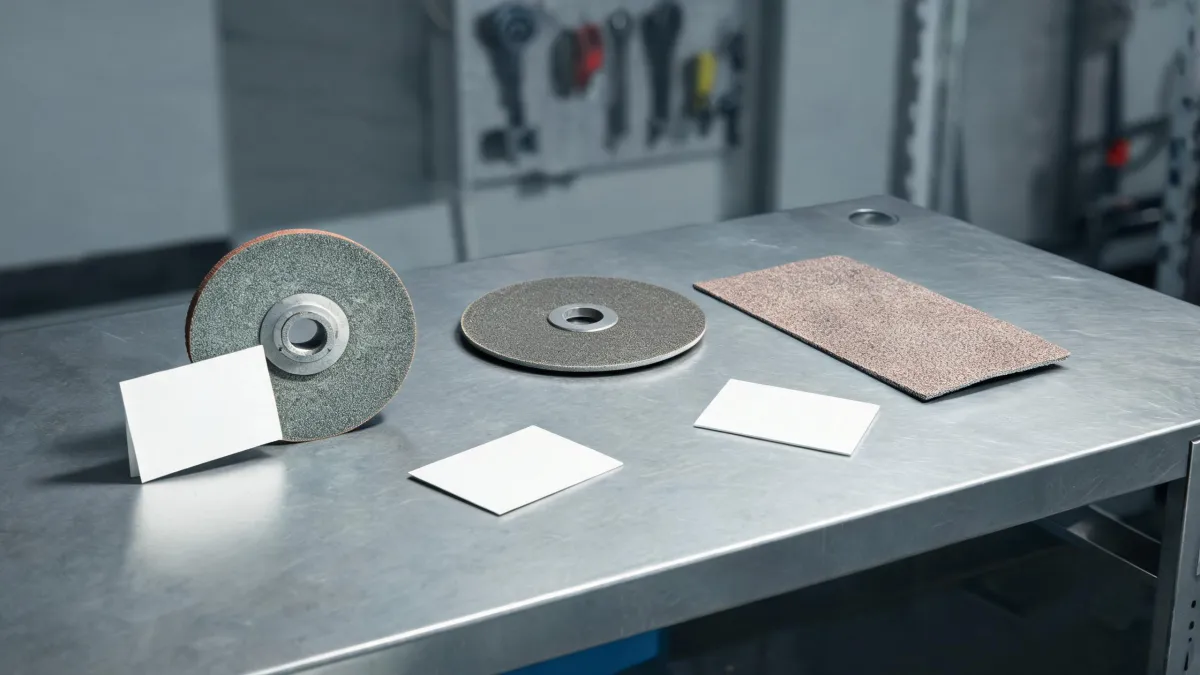
The comparison: catalog-price sourcing vs. total-cost sourcing
I have been handling MRO consumable orders for 9 years. I have personally made and documented 14 significant sourcing mistakes, totaling roughly $18,400 in wasted budget. Now I maintain our team's checklist to prevent others from repeating my errors.
When you are figuring out how to choose angle grinder wheels, or any abrasive product, there are two common approaches. The first is catalog-price sourcing: open a PDF, sort by price, pick the cheapest SKU. The second is total-cost sourcing: verify application, RPM, arbor, material, then compare landed cost and supplier transparency. I used to be a catalog-price guy. After a $1,240 mistake in 2017, I became a total-cost guy.
This is not just about abrasives. The same pattern shows up when buyers download a ball valves catalogue PDF or a router bit catalog: the document gives you part numbers, but it does not tell you whether the part will survive your actual process.
Reference: OSHA 29 CFR 1910.215 covers abrasive wheel machinery, including guard and RPM requirements. ANSI B7.1 is the safety standard for the use, care, and protection of abrasive wheels.
Dimension 1: Sticker price vs. landed cost
Catalog-price sourcing wins on the number that is easiest to see. Total-cost sourcing wins on the number that actually hits your budget.
In 2020, I saved $80 by choosing a cheaper 4.5-inch grinding wheel. The order was 600 wheels. We did not check freight terms or minimum order rules. Freight added $210. Because the wheels arrived without the arbor adapters we assumed were included, we had to buy adapters locally at $1.85 each for 200 wheels. Net loss: $370 plus two days of delay. Not huge. But it taught me to ask what is NOT included before asking what the price is.
Transparent vendors usually show freight, setup, and minimums upfront. The sticker price looks higher. The invoice usually looks lower. That is the transparency point: I would rather pay a known total than chase a low number that grows after PO approval.
Dimension 2: Catalog specs vs. real shop conditions
This is where angle grinder selection gets dangerous. A catalog PDF can list diameter, thickness, arbor, max RPM, and material. It cannot list your grinder's actual RPM under load, your operator's technique, or the fact that your material supplier changed the alloy last quarter.
For angle grinders, the non-negotiables are wheel diameter, arbor size, and maximum RPM. If a wheel is marked 13,300 RPM and your grinder spins at 11,000 RPM, that is fine. If it is the reverse, you have a safety problem, not a sourcing problem. OSHA and ANSI B7.1 both treat that as a hard boundary. I keep a laminated card in the tool crib: grinder RPM first, wheel RPM second, price last. That single change caught 47 potential mismatches in 18 months.
Norton abrasives products usually print the max RPM and application data clearly, but usually is not always. I still verify. I once assumed a same-specification Norton abrasives wheel from a different line would behave identically. It did not. The bond was slightly harder, and on stainless it glazed instead of cutting. We did not scrap the order, but we lost productivity and had to switch wheels mid-job. That is a real cost, even if it never shows up on the PO.
What about ball valves and router bits?
The same comparison applies. A ball valves catalogue PDF may give you pressure rating, port size, and body material. It may not tell you whether the actuator mounting pattern matches your existing bracket, or whether the stem material is compatible with your media. A router bit catalog may give you shank diameter, cut diameter, and flute count. It may not tell you whether the bearing will survive 8 hours of MDF routing. Catalog data is necessary. It is not sufficient.
Dimension 3: Single-brand portfolio vs. mixed-catalog buying
Catalog-price sourcing says piece together the cheapest item from every catalog. Total-cost sourcing says standardize on a portfolio you can verify.
I used to think mixing brands gave us leverage. Sometimes it does. But every new SKU adds a verification burden: new RPM markings, new arbor tolerances, new compatible accessories, new minimum order rules. In 2022, we ran a mixed-catalog test on flap discs. We saved 11% on unit price. Then we spent 6 hours of team time reconciling returns and two partial reorders. At our loaded labor rate, that was $540. The 11% savings was $190. Net loss: $350.
Norton abrasives products are not automatically the right answer for every job. But a broad, documented portfolio makes it easier to standardize the checks: one RPM table, one application guide, one distributor who can answer technical questions. If you are buying 20 wheels a year, mixed catalogs are fine. If you are buying 20,000, the administrative cost is real.
My selection advice
Choose catalog-price sourcing when you are buying a commodity item with no safety-critical RPM limit, you already know the exact SKU, and the total order is under $500. Even then, ask about freight and returns.
Choose total-cost sourcing when the product touches a grinder, a pressure boundary, or a production line. That includes angle grinder wheels, ball valves, router bits, and most Norton abrasives products used in fabrication. For those, get a written quote that shows unit price, freight, minimums, taxes, and return policy. Then verify the physical specs against the tool or system.
My checklist is boring: 1) Confirm grinder RPM and arbor. 2) Confirm wheel max RPM and diameter. 3) Ask what is not included. 4) Get the landed cost in writing. 5) Buy from a supplier who answers technical questions without transferring you four times. That last one is worth more than a 5% discount.
This worked for us, but our situation is a mid-size fabrication shop with predictable MRO ordering. If you are a one-person contractor or a massive plant with automated procurement, your mileage may vary. My experience is based on about 300 orders across abrasives, valves, and tooling. If you are dealing with exotic alloys or high-pressure steam, the stakes are different.
I still keep the 2017 invoice that cost me $1,240. It is taped inside our sourcing binder. It reminds me that the cheapest catalog line is rarely the cheapest decision.

Victor Salcedo
Victor Salcedo is an independent fastener, anchor, and spring analyst covering screws, bolts, nuts, washers, rivets, anchors, compression springs, extension springs, and torsion springs. He uses ISO 898-1 property classes alongside clamp-load, thread engagement, proof load, corrosion exposure, anchor substrate, spring rate, travel, and fatigue-cycle checks. His engineering explainers help designers and buyers specify reliable joints or elastic elements, compare materials and finishes, and avoid mismatched strength assumptions.